Available, But Not Accessible: Whittier's Spanish-Language Outreach Under Question
When the Whittier City Council approved a federal transit equity plan, one councilmember raised a question that goes beyond transportation: is the city actually reaching its Spanish-speaking residents, or just making resources available and hoping they find them?

On April 28, the Whittier City Council approved a federally required transportation equity plan for the city's Dial-A-Ride program. Dial-A-Ride is a city-operated, on-demand transportation service serving Whittier seniors and residents with disabilities.
The plan, required every three years by the Federal Transit Administration, documents how the city ensures its transportation programs are accessible to all residents regardless of race, color, or national origin.
But before the vote, Councilmember Mary Ann Pacheco raised a question about whether posting resources in Spanish is enough.
"We had a discussion between the difference of available and accessible," Pacheco said. "Some things may be available, but if you don't know how to get them, if you don't know they exist, they are in reality not accessible, so they may as well not exist."
Pacheco said she wants the city to more proactively reach residents who speak Spanish as their primary or only language, so they can take full advantage of transportation options within the city.
"I really want to see in the next report that we have consciously and seriously, really beefed up our outreach," she said.
Councilmember Mary Ann Pacheco comments on Spanish language accessibility at the April 28, 2026 City Council meeting (City of Whittier)
What the Plan Says
The Title VI Program Plan, which covers the city's Dial-A-Ride (DAR) program through December 31, 2028, includes a Language Assistance Plan specifically designed to address the needs of residents with limited English proficiency, defined federally as those who do not speak English as their primary language or who understand it "less than very well."
According to 2021 U.S. Census data cited in the plan, approximately 8.6 percent of Whittier's population, roughly 7,033 residents out of 81,890, falls into that category.
The plan outlines a range of language access measures specific to transit services: bilingual English/Spanish brochures distributed at senior and community centers, bilingual staff at the Transit office and on DAR vehicles, and Spanish interpretation available upon request at meetings related to transit services. Some measures extend beyond transportation. Spanish translation is available on the city's website, and interpretation services are offered upon request at City Council meetings.
The plan documents what exists. Pacheco's question is whether residents are actually finding it.
The Gap Between Available and Reached
The Language Assistance Plan acknowledges that roughly 20 percent of DAR riders are bilingual Spanish speakers, but notes that staff often cannot determine whether Spanish-language communication is necessary or simply preferred. The plan also relies heavily on residents finding city resources on their own, through the website, by visiting a senior center, or by already knowing the service exists.
The plan does not describe targeted outreach efforts in specific Spanish-speaking communities.
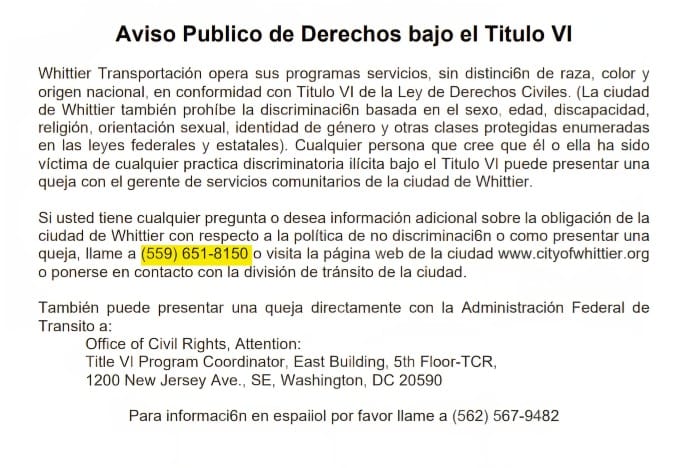
One example stands out. A Spanish-language notice posted on Dial-A-Ride vehicles and at senior centers is supposed to tell riders how to reach the city if they believe their civil rights have been violated. Questions about the level of review given to the Spanish-language version arise from two details: typos in the Spanish text and a wrong number, a 559 area code that reaches Able Inc., a disability employment nonprofit in Visalia, nearly 200 miles away, with no connection to the City of Whittier.
For a Spanish-speaking resident who sees that notice and calls the number listed, it would not connect them to the city's transit services or complaint process.
A Broader Question
Dial-A-Ride is, in many ways, an entry point to a larger conversation. The Title VI plan is specific to transit, but the question Pacheco raised applies across city services: how does a resident who primarily speaks Spanish learn what is available to them, and what does the city do to make sure they do?
The plan was approved unanimously, but Pacheco's comments put something on the record that the next update, due in three years, will need to answer. The question is not whether the resources exist. It is whether residents know they do.
For now, that question remains unresolved.