Whittier Keeps Considering — and Delaying — Stop Signs Its Own Traffic Engineers Rejected
Whittier's traffic engineers rejected stop signs at Anaconda and Hornby — twice. The Council approved them anyway in 2022. The signs still aren't up. Now the vote to formalize it keeps getting delayed.
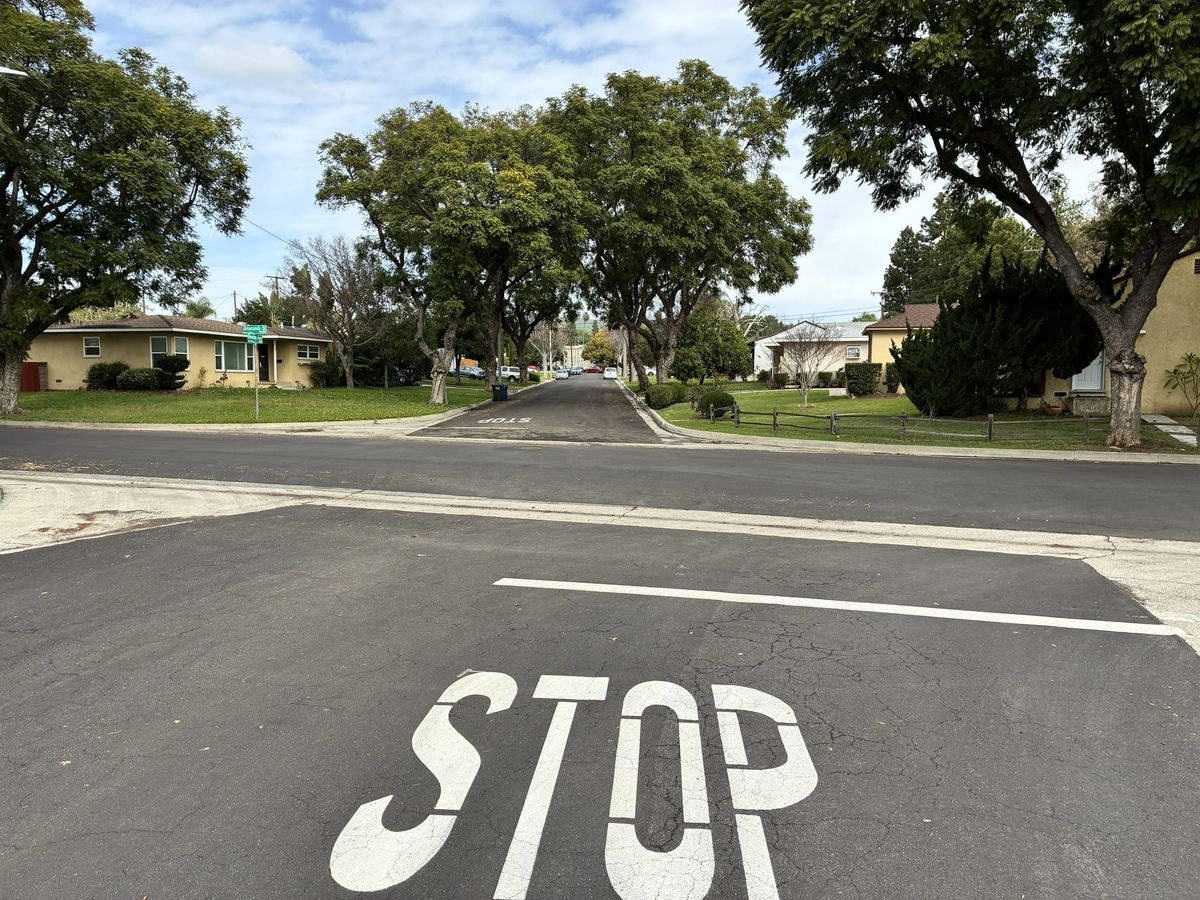
For the second time, a City Council vote on installing stop signs at Anaconda Street and Hornby Avenue was delayed — this time after the item was pulled from Tuesday night's agenda. The vote is expected to be pushed to the next council meeting. It has now been nearly four years since the Council first approved the installation, despite two separate engineering studies recommending against it.
A Single Request
At some point prior to 2018, one Whittier resident requested a multi-way stop at the intersection of Anaconda Street and Hornby Avenue, a residential crossing near Anaconda Park. The city took the request seriously, contracting with RBI Traffic, a professional traffic engineering firm, to conduct a formal warrant study — the state-mandated process for determining whether a stop sign is justified.
What the Data Said
Under California's Manual on Uniform Traffic Control Devices (CAMUTCD), a multi-way stop requires that the major street approach average at least 300 vehicles per hour during the eight busiest hours of the day. At Anaconda and Hornby, that number came in at just 71 vehicles per hour — less than a quarter of the threshold. Minor street traffic averaged just 21 vehicles per hour against a requirement of 200.
The study also found no significant accident history at the intersection over the previous five years. No pattern of collisions. No conditions that would otherwise justify the installation of stop signs.
RBI Traffic's conclusion was unambiguous: the intersection did not meet any of the required warrants. Staff presented the findings to the Parking and Transportation Commission in March 2019 with a recommendation to deny the request. The Commission agreed.
A Second Look, A Second Denial
In December 2021, the city was asked to take another look at the intersection. A new round of traffic counts was collected in January and February of 2022 — two separate collection periods, the second conducted to ensure results weren't skewed by residential tree trimming activity in the area.
The updated data told the same story, only more so. Traffic on Anaconda Street had actually decreased 24% since the 2018 study. The intersection now qualified even less than it had before. City staff again recommended denial. The Parking and Transportation Commission again agreed, voting to deny the request at its May 5, 2022 meeting.
The Council Steps In
The item might have ended there. Instead, a council member pulled it for City Council review. At the June 28, 2022 City Council meeting, council members discussed the Commission's denial. Rather than upholding the recommendation of their own staff and commission, the Council voted to install the stop signs — citing personal experience driving through the neighborhood and community concerns about speeding near the adjacent park.
No new engineering data was presented. No updated traffic study was conducted. The decision rested on anecdotal reasoning that directly contradicted two years of professional analysis.
Four Years of Nothing
Following the June 2022 vote, the stop signs were never installed. No resolution was formally adopted. No installation was scheduled. The intersection sat unchanged for nearly four years while residents who had advocated for the safety measure waited.
It wasn't until February 24, 2026 that the city moved to formally adopt Resolution 2026-13, authorizing the City Traffic Engineer to install stop signs at Anaconda Street and Hornby Avenue at an estimated cost of $3,000. That item was pulled from Tuesday night's agenda before a vote could be taken.
Whittier Informed visited the intersection prior to Tuesday's meeting. The stop signs are not yet installed.
The Liability Question
A stop sign sounds harmless, but when a city goes against its own expert data twice and installs it anyway, the city is less protected from certain lawsuits. This is the same city that has cited sidewalk trip and fall liability as justification for removing trees. Under California Government Code §820.2, cities carry certain legal protections for discretionary decisions — but those protections weaken when elected officials override professional recommendations without technical justification. If someone gets hurt at this intersection, those documents become evidence against the city. In Whittier, that means taxpayers.
What Happens Next
The vote on Resolution 2026-13 is expected to be placed on a future City Council agenda. If adopted, the City Traffic Engineer will be authorized to proceed with installation. The city has not publicly stated a timeline for when the signs would actually go up.
Sources: City of Whittier agenda reports (2019, 2022, 2026); RBI Traffic Multi-Way Stop Warrant Report (2019); Resolution No. 2026-13; California Government Code §820.2