
Measure ER Passes. Whittier's Sales Tax Rate Going Up To 11%
Measure ER brings Whittier's sales tax to 11% starting October 1, while directing $1 billion a year to the county's healthcare system.

Los Angeles County voters approved Measure ER — a measure that does two things at once. Starting October 1, Whittier's combined sales tax rate goes from 10.5% to 11%. And starting that same day, roughly $1 billion a year flows toward keeping county hospitals and clinics open and expanding healthcare access for residents losing Medi-Cal coverage.
Whether that tradeoff works for you depends on your situation. Here's what it means for Whittier.
How close was it?
Very close. Measure ER was losing on election night, June 2, before pulling ahead as more ballots were counted in the days that followed. It passed 50.64% to 49.36%— a margin of roughly 25,000 votes out of nearly two million cast.
The campaigns were far from evenly matched. Supporters raised about $9.7 million, led by St. John's Community Health and backed by healthcare workers' unions. Opponents raised less than $10,000.

What does it mean for your wallet?
Starting October 1, every taxable purchase in Whittier will be taxed at 11% — an extra 50 cents on a $100 purchase, an extra $5 on a $1,000 purchase. The tax does not apply to groceries or medications. It runs for five years and expires automatically on October 1, 2031.
How Whittier compares to nearby cities
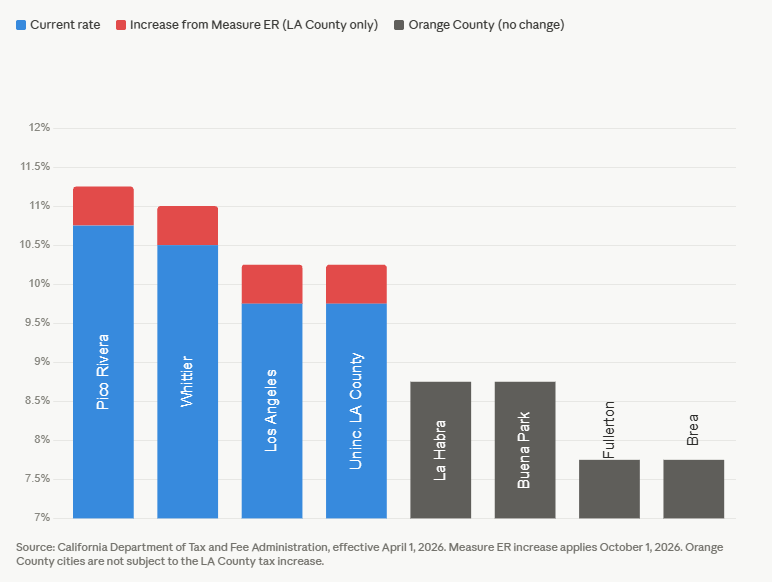
Once the tax takes effect, Whittier's combined rate of 11% will be higher than Los Angeles city and unincorporated LA County, both landing at 10.25%. Neighboring cities in Orange County — which are not subject to the LA County increase — will remain significantly lower. Brea and Fullerton stay at 7.75%, La Habra and Buena Park at 8.75%. Rates sourced from the California Department of Tax and Fee Administration.
That gap is worth noting. A Whittier resident buying $1,000 worth of goods in Brea would pay $77.50 in sales tax compared to $110 at home — a difference of $32.50. For bigger purchases like appliances or furniture, the savings from crossing the county line add up quickly. It's the same concern opponents raised during the campaign — that higher rates push shoppers toward neighboring communities with lower tax burdens.
One more step: California's base sales tax rate is 7.25%, and the state caps how much cities and counties can add on top of that at 2%. A few cities — including Pico Rivera, once Measure ER kicks in — are already brushing up against that ceiling. For those cities, the increase still needs sign-off from the state legislature before it actually takes effect, and that hasn't happened everywhere yet.
What does Measure ER give in return?
The county estimates Measure ER will generate about $1 billion a year for the next five years — roughly $5 billion total. That money is meant to keep nonprofit clinics serving uninsured and low-income patients open, fund county hospitals and clinics, and support public health programs.
For residents who rely on Medi-Cal or community clinics for their healthcare, this is significant. Six of LA County's 13 public health clinics have already closed following federal funding cuts. Measure ER is designed to stop more from closing — and to help cover people who lose their Medi-Cal and have nowhere else to turn.
Measure ER is a general tax, so the money goes into the county's general fund — not a dedicated healthcare account. The spending plan is a commitment from county supervisors, not a legal requirement. The measure does require annual independent audits and creates a nine-member oversight committee to publicly track how the money is spent.
Who benefits — and who doesn't?
The answer depends on your situation.
If you're on Medi-Cal: This was built for you. The money is meant to keep clinics open and create a local coverage program for people who lose Medi-Cal and have no other options.
If you're uninsured: You benefit too. A large share of the spending plan goes to clinics offering free or low-cost care — the ones most at risk of closing without new funding.
If you have an HMO or PPO: The benefit is indirect. When clinics close, uninsured patients end up in emergency rooms, driving up wait times for everyone. Measure ER is designed to reduce that pressure.
If you're low-income: Sales taxes hit harder on smaller incomes. You'll pay into this tax like everyone else, even though the healthcare it funds serves lower-income residents most. Note that groceries and medications are exempt.
If you're higher-income: You'll pay more in raw dollars but are less likely to depend on the services being funded.
Either way: If you shop in Whittier, you'll pay this tax starting October 1.
Why did supporters push for it?
Federal budget cuts — under a law called H.R. 1, or the One Big Beautiful Bill Act, signed July 4, 2025 — are projected to cost LA County's health system $2.4 billion over the next three years. Six clinics have already closed. Supporters argued that without new funding, more closures were coming, pushing uninsured patients into emergency rooms and straining care for everyone. California's own Medi-Cal cuts added to the pressure, with the state freezing new enrollment for undocumented adults and planning to add premiums for some enrollees in 2027.
Why did opponents push back?
Critics argued LA County residents are already among the most taxed in the country and that sales taxes hit low-income people hardest. Some city leaders across LA County questioned whether the county would spend the money as promised, given that the measure's general fund structure gives supervisors broad discretion over spending. Voters in Contra Costa County rejected a similar healthcare tax at the same election, with 57% opposed.