
Whittier Is Voting on Term Limits. But Everyone Starts at Zero
The Whittier City Council voted Tuesday to let residents decide two things: when city elections are held, and whether to impose term limits for the first time.
Whittier residents will vote this November on whether to add term limits to City Hall for the first time. They will also decide whether to move city elections from April to November's statewide general election. These measures will be on the November 3, 2026 ballot after the Whittier City Council voted Tuesday to put them there.
Both measures would change Whittier's city charter — the document that sets the ground rules for how the city governs itself. And under California law, residents are the only ones who can change it.
"I want to be clear to the public. This is not us deciding. This is us giving it to the voters to decide," Council Member Vicky Santana said Tuesday.
Term Limits: The Clock Starts Fresh
The term limits measure would cap how long anyone can serve as mayor or on the city council at 12 total years. If someone wants to run for office down the road and winning that seat would push them past the 12-year mark, they cannot even file the paperwork to get on the ballot — not even as a write-in.
To understand what a 12-year cap could mean going forward, consider the council members just voted out. Joe Vinatieri served 20 years in Whittier city government, first elected to the city council in 2006 before becoming mayor in 2016. Fernando Dutra served 14 years on the council, first appointed in 2012. If a 12-year cap had applied to all their years served, neither could have stayed that long.
The 12-year clock only starts counting after November 3, 2026. Any years already served in office do not count toward the cap. Everyone essentially starts from zero.
Council Member Cathy Warner is the clearest example of how this works. Warner was first elected in 2004 and is currently in her 22nd year of service, with her current term scheduled to run through 2028. If the measure passes, none of those years would count toward the 12-year cap. She starts at zero.
That was confirmed at Tuesday's meeting, when Council Member Mary Ann Pacheco asked the City Clerk directly. Years already served do not count. The clock starts the day the measure takes effect.
Whittier's City Clerk explains the measures during the June 23 city council meeting (Video: City of Whittier)
The 12 years do not have to be consecutive. It is a lifetime total, and years served as a council member and years served as mayor are counted together toward the same cap.
To pass, the measure needs more than half of all votes cast in November to say yes.
The Election Date: Whittier Has Been Here Before
The second measure would move Whittier's general municipal election from April to November, consolidated with the state's general election.
For Whittier, this would not be the first time.
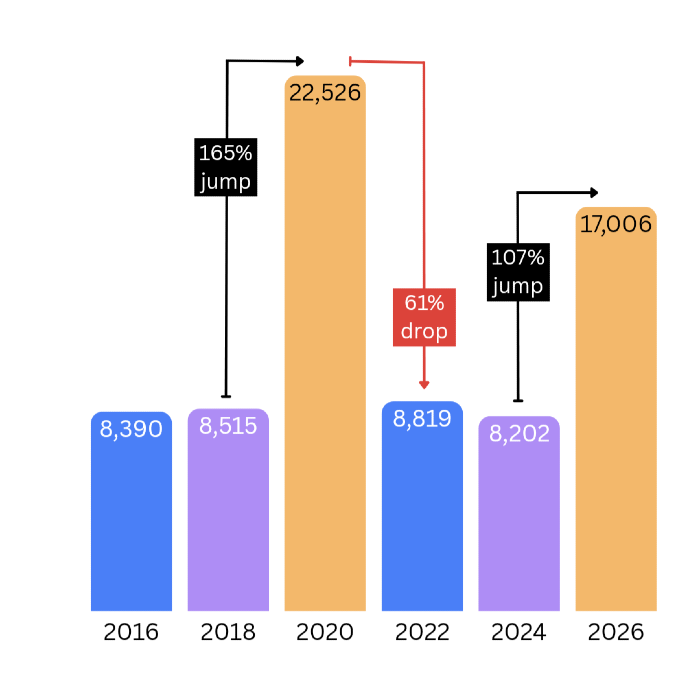
Whittier holds its elections on its own schedule in April rather than alongside state or national elections. In 2020, under pressure from a state law called the California Voter Participation Rights Act (Senate Bill 415), Whittier moved its election to coincide with the state's March primary. The result was immediate: 22,526 ballots were cast, nearly three times the typical April total, because residents were already going to the polls for the presidential primary.
Then a court case changed things.
The City of Redondo Beach had sued the state, arguing that charter cities have the constitutional right to set their own election dates regardless of what state law says. In 2018, a Los Angeles Superior Court agreed, and a California appellate court affirmed that ruling in March 2020. The Court of Appeal decision remained in place.
With the legal pressure gone, Whittier's council voted 4 to 1 in 2021 to move the election back to April. Turnout dropped 61% in the very next election in 2022.
Now the council is asking voters to move it again. This time it is voluntary, and the destination is November rather than March.
The three members who led Tuesday's vote — Mayor Becerra, Council Members Santana and Macedo — were all candidates running for office just two months ago. At election forums leading up to the recent election, all three said publicly that they would support both term limits and moving the election to align with a statewide date. Voters elected all three, and Tuesday's vote is them following through.
Not every council member is convinced the move is the right call. Council Member Cathy Warner voted yes but made clear she had reservations.
"We are giving up our election sovereignty, and we've had a great record for many, many, many years when the city holds its own elections," Warner said.
She also pushed back on the assumption that moving to November automatically means more Whittier residents will participate. "There is no guarantee of a greater turnout," she said.
Warner also noted that consolidating with the county means election results could take up to 30 days to come in, compared to the faster turnaround Whittier has seen running its own elections.
Who Gets to Argue for the Measures
When Whittier residents open their voter information guide this November, they may find an official written argument — essentially, a case for why voters should say yes — in favor of both measures. The council authorized Council Members Macedo and Santana to write it, though the resolution says they are not required to do so. No council member was designated to write an argument against either measure.
That does not mean opposition is closed off. Any resident can submit a written case against the measures through the City Clerk's office before the deadline the clerk sets. The City Attorney is also required to prepare a separate neutral analysis of each measure, no longer than 500 words, which will appear alongside the arguments in the voter guide.