The Rules for Speaking at Whittier City Council Just Changed
Whittier's new council dropped the speaker card requirement and set a flat two-minute limit for all speakers — changes that roll back policies put in place by the administration that was voted out in April.
At nearly every city meeting, there is a stretch of time set aside for residents to step up to a microphone and tell their elected officials what is on their mind. This is called public comment, and it is the main way ordinary people get a say in front of the City Council.
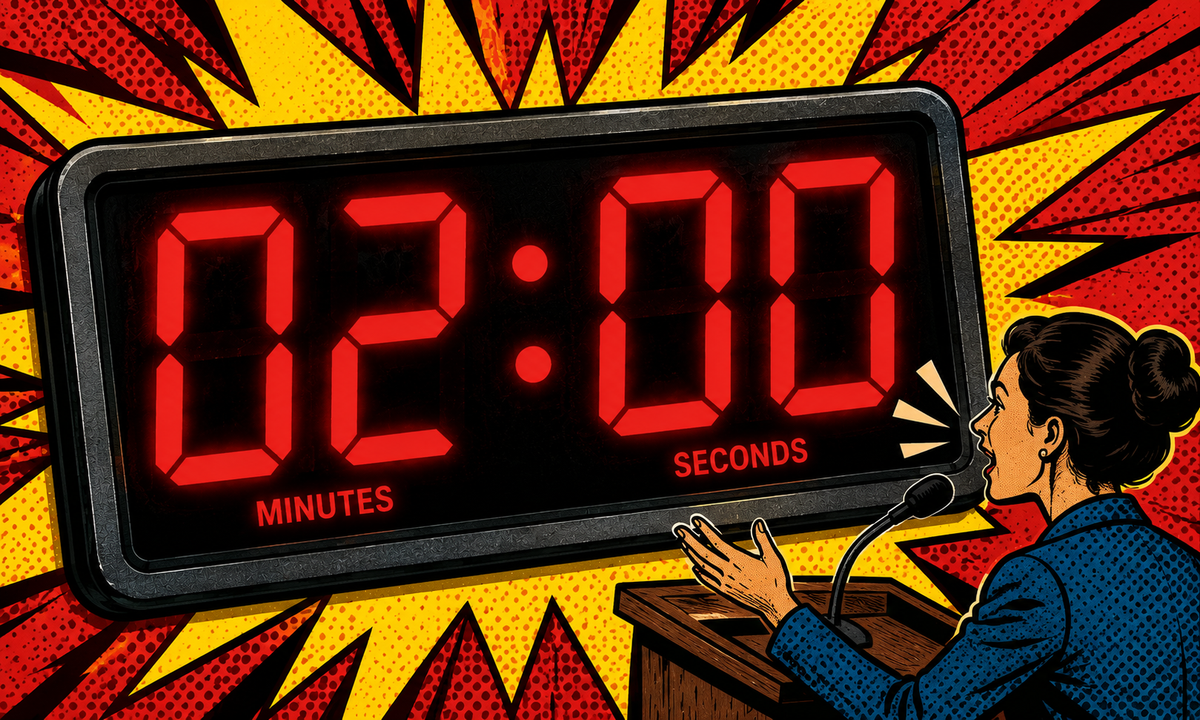
On May 26, the Whittier City Council changed the rules for how public comment works. The council dropped a requirement that residents fill out a card before they could speak and set a single two-minute time limit for all speakers. The changes apply not only to the City Council but to all of the city's appointed boards, including the Planning Commission, which reviews land use proposals, and the Historic Resources Commission, which deals with older and historic buildings.
What changed
Under the new rules, each person gets two minutes to speak regardless of how many people attend. Residents no longer have to fill out a speaker card or take a number. Speakers also cannot use a phone or other device to let an absent person deliver comments through it at the podium. Anyone who wants to speak forms a line behind the microphone, holding a spot for someone else is not allowed, and residents who cannot stand for long periods may remain seated until their turn.
The person running the meeting, usually the mayor, may make small adjustments to how the rules work on a given night. The one exception is the time limit, which must be strictly enforced.
What the old rules required
The new policy replaced two earlier sets of rules, both passed unanimously by the previous council that was voted out in the April 14, 2026 election.
The first was a speaker card system adopted in January 2026 that required residents to submit a card before a specific point early in the meeting. After that, no new cards were accepted, meaning a resident who arrived late could be turned away from the microphone entirely. Like other changes the previous council made to public comment, the card policy arrived without advance public notice or explanation.
The second was a set of time limits from July 2024 that started each speaker at three minutes but dropped to two minutes once 21 people signed up and to one minute once 41 or more were in line. The meeting's leader could also cap the total time for all public comment. The new policy replaces all of that with a flat two minutes for every speaker, every time.
More changes under the previous council
The speaker cards and time limits were not the only restrictions the previous council and administration put in place. Between October 2024 and November 2025, the city made three changes to its meeting livestream, each without public explanation: it stopped showing residents at the microphone, then replaced the live view with a static slide, and finally removed the audio entirely. Then-Mayor Joe Vinatieri told the Whittier Daily News the broadcast changes were in response to concerns that some comments had made residents feel unsafe.
State law requires cities to allow public comment but does not require them to broadcast it. Residents could still participate in person or by Zoom, but those watching from home lost the ability to follow what their neighbors were saying to the council.
At its first meeting, the new council restored the livestream, once again showing residents at the microphone.
What the council said
Councilmember Aida Macedo, who introduced the two-minute proposal, said the goal was predictability. Under the old sliding scale, a resident who prepared a three-minute comment might arrive to find the limit had already dropped, depending on the crowd size. A flat limit means every speaker knows exactly how much time they have before they walk in.
That raises the question of why two minutes rather than three. Councilmember Vicky Santana said two minutes is enough for a prepared speaker, noting that it is easy to tell when someone is not ready, as they often keep talking past the point they already made, filling time without adding anything new.
Mayor James Becerra said goals of fairness, efficiency, and accessibility guided the changes. He also said that using a device to deliver someone else's comment at the podium had caused disruptions at past meetings, and the new rule addresses that.
How Whittier compares to nearby cities
Public comment time limits at eight nearby city council meetings:
- One minute: City of Industry
- Two minutes: Whittier
- Three minutes: La Habra, Santa Fe Springs, Pico Rivera, Montebello, El Monte
- Five minutes: La Habra Heights, South El Monte
Seven of the eight cities reviewed allow more time per speaker than Whittier. Only the City of Industry allows less.
What residents said
Not everyone at the May 26 meeting was satisfied with the new approach.
Resident Michelle Alvarado said public comment is one of the few direct ways residents have to speak to the people who represent them, and that the community has made clear its desire for open, ongoing communication with city leaders.
Helen Rahder, executive director of the Whittier Conservancy and a former Whittier mayor pro tem (the council's second-in-command) focused her concern on public hearings.
Unlike general public comment, a public hearing is called for a specific decision, such as a proposed development or land use change, where residents who live nearby can formally weigh in before the council or a city commission votes. Their testimony becomes part of the official record and can directly influence the outcome.
Rahder said that capping that testimony at two minutes could silence the people with the most direct knowledge of what a project would actually mean for their neighborhood.
What stayed the same
Someone who submitted a formal application to the city, or who filed an official appeal of a city decision, still gets more time to make their case at those public hearings: 20 minutes to present and 10 minutes to respond.
A rule allowing the meeting's leader to cut off a speaker for being disruptive, repetitive, off topic, or raising something outside the council's authority also remains in effect. And while the new rules describe speakers lining up in person, they say nothing about remote participation. The card rule they replaced had directed people joining by video call to raise a virtual hand before the comment period began. No equivalent step exists in the new rules.