Three Budgets Passed Tuesday. One Raises Your Water Bill
Most residents only heard about the city budget. But two more budgets passed Tuesday night.

The Whittier City Council's 2026-27 budget vote Tuesday night was actually three votes in one. The same five council members also sit as the board of the Whittier Utility Authority, which runs the city's water, sewer and trash services, and the Whittier Housing Authority, which holds housing funds left over from a state program that ended in 2012. All three budgets passed on Tuesday.
Here is what it means for residents.
Your water bill is going up in January
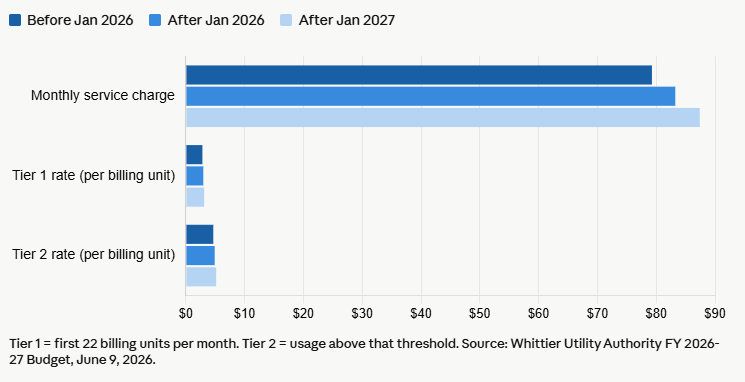
If you are a Whittier water customer, your bill is going up again in January 2027. Here is what changes:
- The base monthly service charge, the flat fee every customer pays regardless of usage, goes from $83.22 to $87.39 per month.
- The standard usage rate goes from $2.96 to $3.11 per billing unit.
- The rate for higher usage, above the standard threshold, goes from $4.90 to $5.15 per billing unit.
These are not the first increases. The same rates went up in January 2026 as well. Combined, the monthly service charge alone has risen from $79.25 to $87.39 over two years, an increase of about 10 percent, before a single drop of water is counted.8
Both rounds of increases come from a rate study the council approved in November 2024.
Sewer and trash are going up too
Sewer fees stay the same through December, then increase from $1.26 to $1.30 per billing unit starting in January.
The city's landfill tipping fee, which is what trash haulers pay when they drop off waste at the landfill, increases from $61.45 to $64.55 per ton. Residents do not pay this fee directly, but haulers may pass cost increases like this along to customers over time.
Where the utility money goes
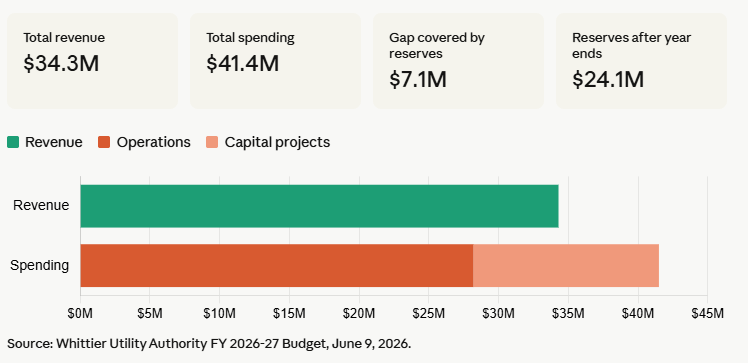
The Utility Authority expects to bring in $34.3 million this year and spend $41.4 million, including $13.3 million on infrastructure projects such as pipes, equipment and water system upgrades. The gap between revenue and spending comes out of reserves the authority has built up over the years. Those reserves are projected to drop from $31.7 million to $24.1 million.
The largest single area of spending is on water infrastructure. The city is directing $7.3 million toward water system projects this year, with another $10.9 million kept in reserve to address new state water quality requirements and future projects in the city's Water Master Plan, a long-range plan for maintaining and upgrading Whittier's water system.
One figure in the budget stands out. The solid waste fund, which covers trash disposal operations, is projected to end the year with just $582,734 in available funds after spending $4.4 million on capital projects. The fund handles nearly $8.9 million in annual operations. According to the budget documents, no explanation is provided for why the working balance is projected to be that low.
The Housing Authority: what is it?
The Whittier Housing Authority is the part of city government most residents have never heard of. Here is what it is and why it exists.
In 2012, the state of California shut down all local redevelopment agencies. These were city-run bodies that used a portion of local property tax revenue to fund affordable housing and economic development projects. When Whittier's redevelopment agency closed, the city created the Housing Authority to manage what remained: housing-related funds, properties and outstanding loan repayments connected to old redevelopment projects.
The Housing Authority is not a general housing assistance program. It does not handle landlord-tenant disputes, rental assistance or Section 8 vouchers. It manages a specific and shrinking pool of money tied to the city's former redevelopment work.
This year, the Housing Authority expects to bring in $120,000 in revenue and spend $349,288. It is drawing the difference from its existing fund balance, which is projected to drop from $3.6 million to $3.4 million by next June.
At the current rate of spending, that fund balance would last roughly 15 years. What the council chooses to do with those remaining housing funds before they are depleted.
Why these budgets get less attention
These budgets are adopted at the same meeting as the main city budget, typically late in a long evening. The same five council members vote on all three. But the money is legally separate from the city's General Fund.
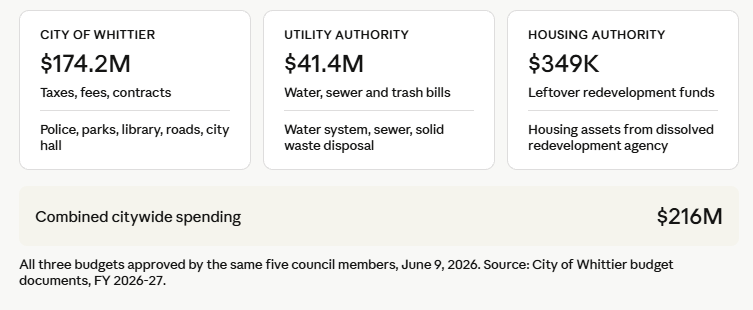
Utility revenue comes from water, sewer and trash fees paid by customers, not from taxes. Housing Authority funds are restricted by law to housing-related purposes. That is why these dollars appear outside the main city budget, and why the combined total across all three budgets adds up to $216 million in citywide spending, not the $174 million figure in the main city budget.
What to watch
- January 2027, when the new water and sewer rates take effect on bills.
- Whether the solid waste fund's low year-end balance leads to additional fee discussions in the next budget cycle.
- What the council decides to do with the Housing Authority's remaining $3.4 million in housing funds.
The full budgets will be available on the city's website and at the City Clerk's office at 13230 Penn Street.
Sources: Whittier Utility Authority Agenda Report and Resolution No. WUA-2026-06, June 9, 2026; Whittier Housing Authority Agenda Report and Resolution No. WHA-2026-02, June 9, 2026; WUA and WHA Unappropriated Fund Balance Summaries, FY 2026-27.