Tired of Uptown's Empty Storefronts? These Residents Are Doing Something About It
There's a grassroots effort mapping Uptown Whittier's vacant storefronts and surveying residents on what should fill them.
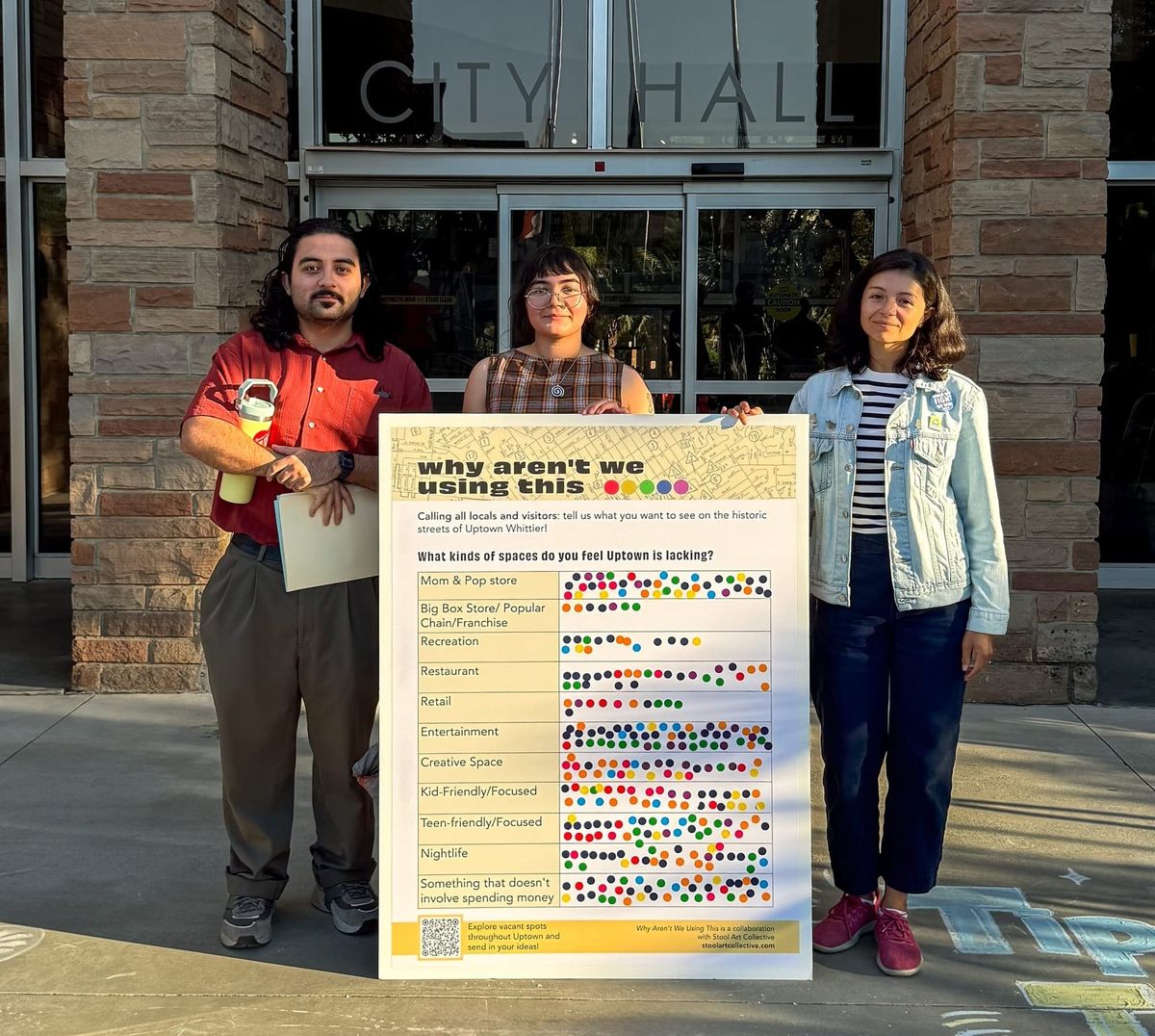
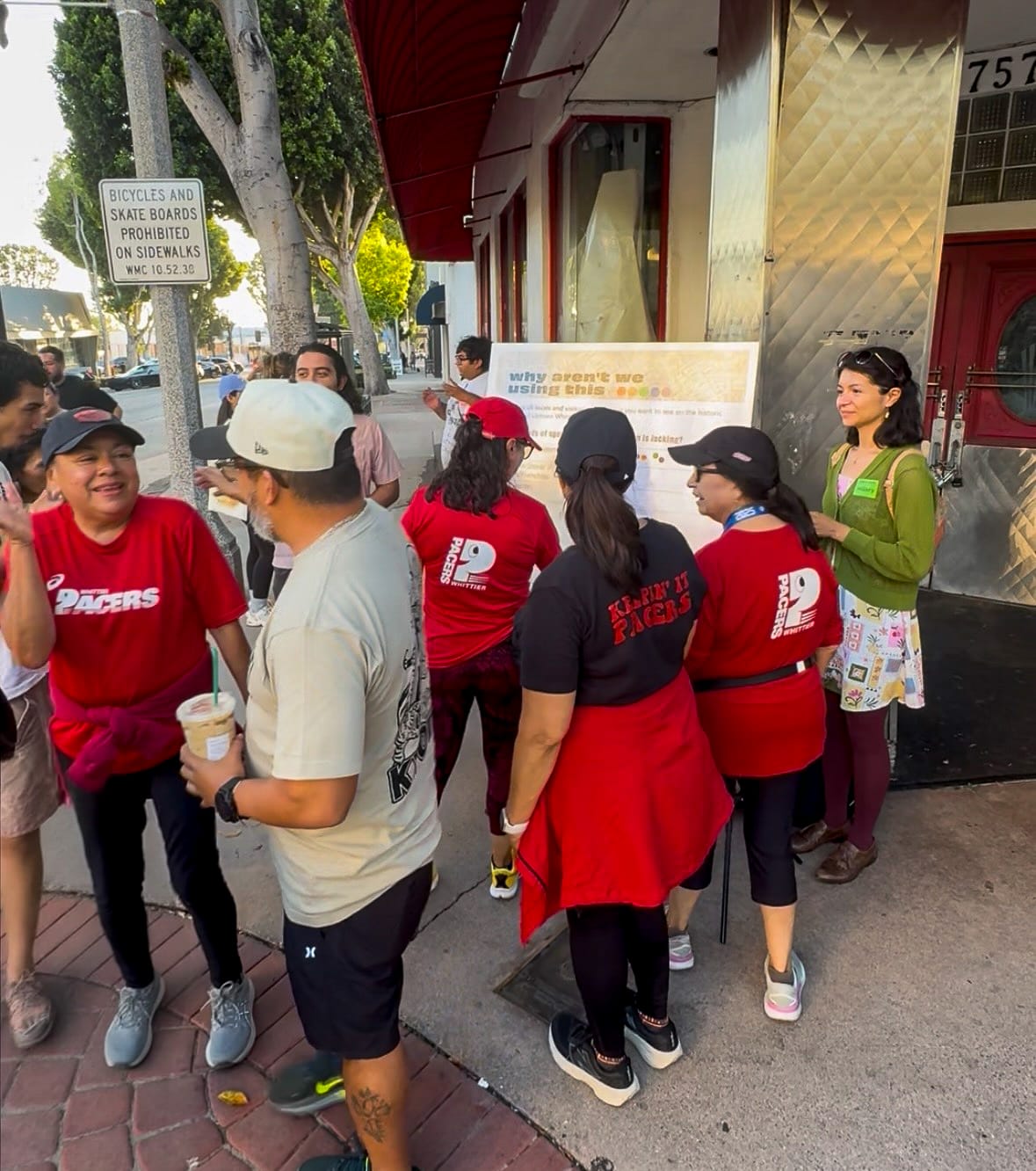
On a recent night market evening in Uptown Whittier, Julian Sanchez, Daria Ancona and Hillary Griffin set up a folding table on the corner of Greenleaf Ave and Philadelphia St. Behind them sat an empty storefront. It used to be Rocky Cola Cafe, a diner that had anchored one of Uptown's busiest corners for 32 years before high rent pushed it out in January 2022. In front of the table, residents stopped to talk about what they wished was there instead.
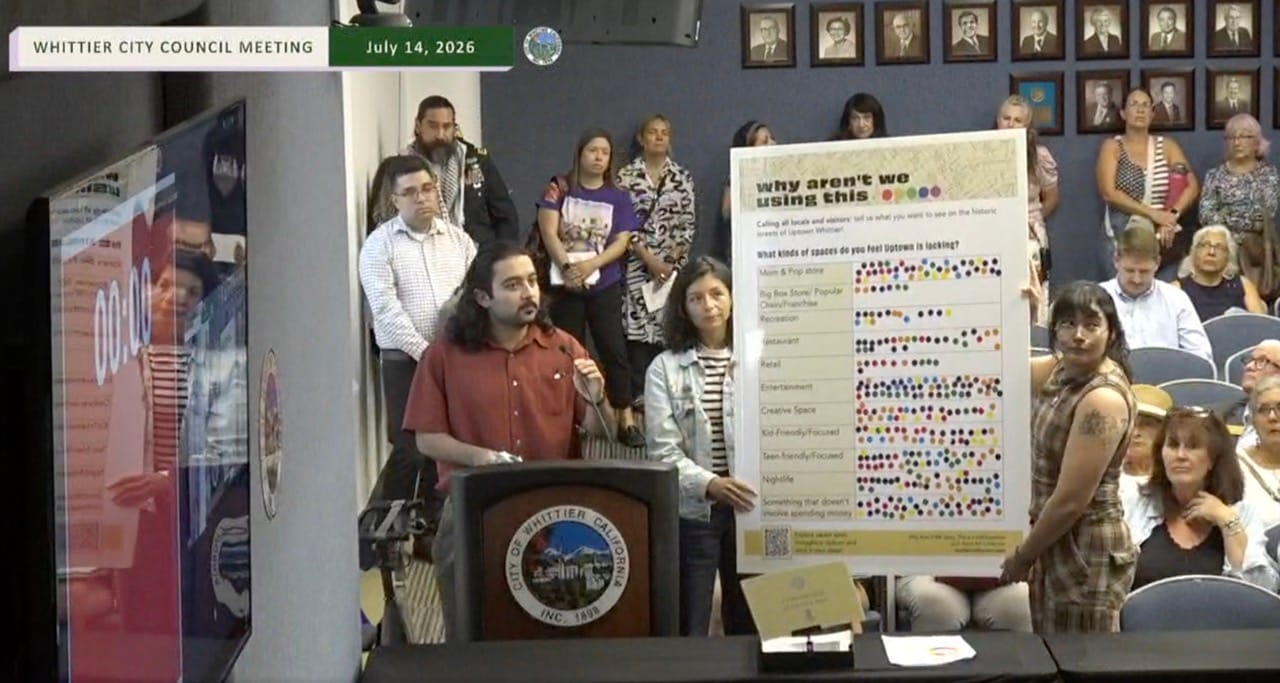
The three call their project Why Aren't We Using This, or WAWUT for short. It started as an online map that marks empty storefronts and lots across Uptown. Alongside the map, they created a survey that asks residents and visitors simple questions: what does Uptown need, and what would you like to see fill a specific empty space?
Signs of a shifting city
Walk through Uptown Whittier, and empty storefronts or vacant lots are hard to miss. Some sit vacant for months. Others sit vacant for years, changing hands without ever reopening. WAWUT's organizers say they got tired of wondering why, so they decided to start collecting evidence instead.
Their timing isn't an accident. Whittier recently elected two new City Council members and a new mayor, James Becerra, in a shift the organizers call a "historic sweep." All three said that change is part of what pushed them to act now, after years of feeling like resident input on Uptown went nowhere.
"I think a big motivator to put this project into motion was the changing of the City Council, just because of how generally dismissive the previous City Council was," Sanchez said.
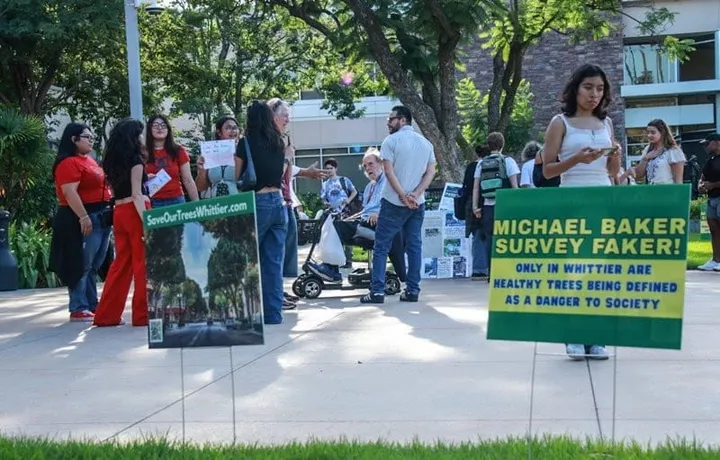
Another example that motivated them: Save Our Trees Whittier, a petition effort that gathered more than 8,000 signatures against removing mature trees along Greenleaf Avenue to build a promenade, shows them that sustained pressure from residents can eventually pay off in Whittier, even if it takes years.
Who's behind it
Each of the three organizers came to the project a different way.
Sanchez grew up near Central Park in Uptown and still lives within walking distance of it. He graduated from Cal State Fullerton with a bachelor's degree in studio art, and said his own art often deals with who owns a space and who's allowed to exist in it. He founded Stool Art Collective while still in school. Its members live all over the region and they came together partly because Cal State Fullerton, a commuter school, didn't offer much of a built-in community. Sanchez said that same drive, to build community where it doesn't already exist, carried over into WAWUT.
He mentioned businesses Uptown has lost over the years, including an independent bookstore and an ice cream parlor that once stood near the Starlight Movie Theatre, as the kind of places that gave the area character.
Ancona grew up in South Whittier, just across the line from the city, and has watched Uptown's mix of businesses shift for years. She's a UC Master Gardener and serves as treasurer of 562 Arts, a newly formed nonprofit. She traces her drive for the project back to her last year at UC Berkeley, where she volunteered at the Guild Tract, an urban community farm. The land was originally slated for big box development, until residents organized to save it for agriculture instead. Ancona said watching that fight succeed, and working alongside the farm's organizers, showed her what sustained community pressure can accomplish.
She pointed to Uptown 2000, a longtime retailer on Greenleaf Ave, as proof that a business can last in Uptown if it fills a real need. She also mentioned Legends, a skate shop that used to draw teenagers, as an example of what's missing now that it's gone.
"I feel like young people these days, middle schoolers, high schoolers, might be getting a lot of the 'no loitering' talk," Ancona said. With Legends closed, she said, there isn't a clear place left for teenagers to just be.
Griffin moved to Whittier from Torrance around 2022, close to Central Park. She works as a multimedia designer at Cal State Dominguez Hills, which she said is known among the CSU campuses as a "hidden gem", a label she said really means the university is underfunded, despite its roots in the aftermath of the Watts Rebellion. Griffin said she noticed a familiar pattern once she moved to Whittier: a place known for its potential that hasn't fully lived up to it. After buying a home here, she said she doesn't want that to stay true.
What the survey is finding
The survey asks people whether they live within walking distance of Uptown, how often they visit, and to pick from a list of what Uptown could use more of.
So far, the top answers are entertainment, including performance spaces, locally owned mom-and-pop shops, and free or low-cost places to gather.
Ancona said that last one matches what all three organizers describe: a shortage of places where young people can spend time without having to pay for it.
Coming in last was big box stores or chain and franchise brands.
The survey also asks people to name a specific empty address and describe what they'd like to see there. WAWUT plans to feature some of those ideas in future posts, including hand-drawn renderings of what the spaces could look like.
No local vacancy tax on the books
Whittier's municipal code touches vacant properties through a maintenance rule. It requires owners of empty lots to landscape, secure and maintain them, and lets the city step in if a property becomes a public nuisance, a legal term for conditions that harm the surrounding area. Whittier Informed reviewed the code and found it doesn't include is a tax, a public registry, or any fee tied to how long a space sits empty.
Whittier Informed reached out to Mayor Becerra and Ben Pongetti, the city's community development director, asking whether Whittier has any tax, registry or other accountability measure for vacant commercial properties, or whether the city has had any discussions on the topic. Neither had responded as of publication.
How San Francisco does it
Other cities have gone further. San Francisco taxes owners, tenants or subtenants who leave certain ground-floor, street-facing commercial spaces empty for more than 182 days a year in specific neighborhood shopping districts across the city. The longer a space sits vacant, the more it costs: $250 per linear foot of street frontage the first year, $500 the second, and $1,000 a year after that, according to the city's Office of the Treasurer and Tax Collector. The city also publishes each property's vacancy status as public data.
Long Beach's approach
Long Beach does something similar. A vacant lot there can mean an empty piece of land, or a building that's sat abandoned, vacant or unleased for more than 30 days. Owners have to register within 30 days and pay an annual fee that keeps renewing as long as the space stays empty, or risk a lien on the property. If they let the space serve the community instead, through something like urban agriculture or a community garden, they can qualify for a fee waiver. The city adopted the rule in 2017.
California considered a vacancy tax, then dropped it
A statewide push, Senate Bill 789, would have gone further still, taxing vacant commercial property $5 a square foot a year across California. After pushback from commercial property groups, lawmakers rewrote the bill to drop the tax and keep only a requirement that owners report vacancy data. But the bill stalled and was defeated in the Senate Appropriations Committee in 2025, killing both the tax and the reporting requirement. Neither ever became law.
What's next
The three organizers say collecting data is only the first step. They want to turn what they learn from the survey into real proposals for the city, not just a one-time snapshot.
"I think that's a big goal for WAWUT, to kind of go beyond the data collection and actually propose actionable items for people to move on," Sanchez said.
For now, that means more mapping, more surveys, and more conversations with residents in Uptown.