
Historic Night in Whittier: First Latino-majority Council, New Mayor, Doubled Turnout
Whittier's April 14 election delivered a series of milestones that haven't been seen in the city's 128-year history — and in some cases, ever.
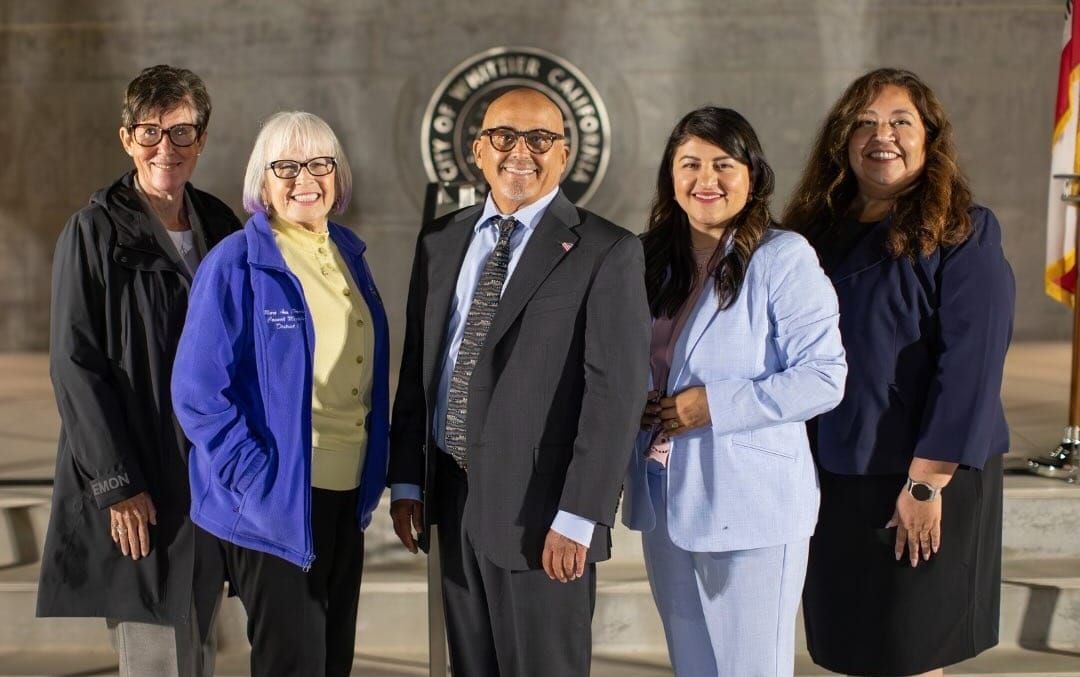
Whittier's April 14 municipal election delivered a series of milestones that will reshape the city's government for years to come. Voters ended a decade-long mayoral tenure, flipped the city council from Republican to Democratic control, and elected the first Latino-majority council in the city's 128-year history.
James Becerra defeated incumbent Mayor Joe Vinatieri with 67% of the vote. Vicky Santana defeated incumbent Councilmember Fernando Dutra in District 2. Aida Macedo defeated incumbent Councilmember Octavio Martinez in District 4. All three challengers were endorsed by the Los Angeles County Democratic Party. The races were officially nonpartisan. Voter turnout doubled compared to recent city elections.
The End of an Era: Vinatieri's 20-Year Run
Joe Vinatieri first joined the Whittier City Council in 2006 under the city's old at-large election system, in which all voters citywide chose every council seat. He served on the council continuously for 20 years.
In 2016, when Whittier implemented district-based elections and created a separately elected citywide mayor's race for the first time, Vinatieri won that inaugural election. He held the directly-elected mayor's seat for the next 10 years — the only person ever to hold that position — until voters removed him on April 14, 2026.
From All-Republican to Democratic Majority
As recently as 2024, all five Whittier City Council seats were held by Republicans. That changed when Mary Ann Pacheco defeated incumbent Jessica Martinez to flip District 3. Even so, Republicans still held a four-to-one majority heading into this year's election. The victories by Becerra, Santana, and Macedo completed the flip. Four of the five council seats are now held by Democrats. Cathy Warner is the sole remaining Republican member.
While Whittier's municipal elections are officially nonpartisan, the April 14 race drew unusually overt party involvement on both sides. Vinatieri leaned into his party affiliation openly. His campaign materials labeled him the "Republican's Choice," and at a meeting with Young Republicans Los Angeles and Log Cabin Republicans LA, he told the group, "We're a red city."
The remark spread widely online, sparking debate about the political identity of a city that votes Democratic in state and federal races but had been governed locally by Republicans for decades. His campaign also carried endorsements from the Republican Party of Los Angeles County and the Lincoln Club of San Gabriel Valley.
On the other side, the LA County Democratic Party endorsed all three challengers, recruited volunteers, and ran ads on their behalf. The party's chair, Mark Ramos, attended campaign rallies alongside the three endorsed candidates in the weeks leading up to the election.
Turnout Doubles — But the Gap Remains
Whittier has more than 55,000 registered voters. In the 2024 municipal election, roughly 8,000 of them voted. After that election, Mayor Joe Vinatieri was asked about the low turnout by the Whittier Daily News. He said: "Those who wanted to vote, voted and there's no real excuse other than you chose not to vote."
Two years later, turnout jumped 107% — the highest the city has seen in recent April cycles. The competitive mayoral race, an energized electorate, and months of community organizing all contributed to the surge.
Even so, overall turnout on April 14 still came in at 28.76% of registered voters — a reminder of the limits of asking residents to show up when nothing else is on the ballot. Becerra, Santana, and Macedo have all said moving Whittier's elections to the same date as state and federal elections is a priority for the new council.
First Latino-Majority Council in 128 Years
The April 14 results also produced what the LA Times reported as the first Latino-majority council in Whittier's 128-year history, raising the number of Latino council members to four.
The milestone caps more than two decades of organizing. In the city's first 115 years, only one Latino had ever been elected to the city council. Since 2000, nine Latino candidates ran for council under the at-large system and not one won.
A 2013 lawsuit documented the pattern in detail. The complaint argued that the city's at-large voting system and standalone April election date together diluted the voting power of Latino residents — meaning their votes carried less influence over election outcomes — in violation of the California Voter Rights Act.
Vinatieri's first council win in 2006 was among the elections cited as evidence. According to the complaint, filed in Los Angeles Superior Court, Latino candidate Alex Moisa received support from 87% of Latino voters in that race but only 22% of non-Latino voters. Vinatieri received 76% of the non-Latino vote and less than 1% support from Latino voters, winning 3,901 votes to Moisa's 2,677.
The city was sent written notice twice — in June 2011 and again in June 2013 — and refused to act both times. It settled in 2014, agreeing to end at-large voting and create four council districts. A Latino candidate won a council seat the following year.
(The 2013 voting rights lawsuit filed against the City of Whittier by residents Jafet Diego, Miguel Garcia, and Lisa Lopez, challenging the city's at-large election system and April election date as discriminatory toward Latino voters.)
First Mayor With a Latino Surname Since 1990
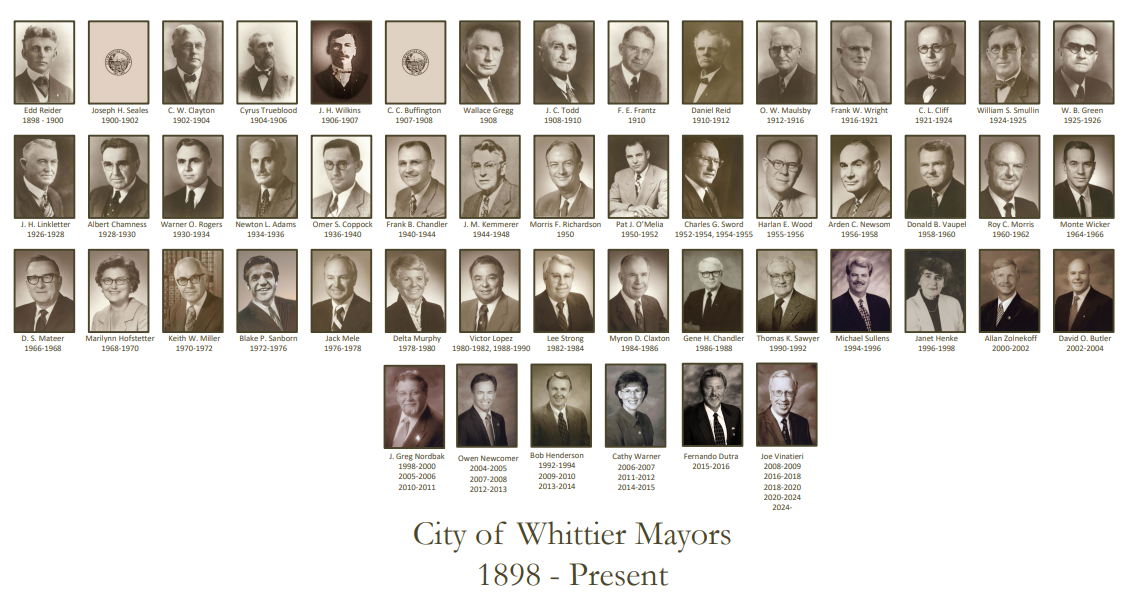
City records show that Victor Lopez served as Whittier's mayor from 1980–1982 and again from 1988–1990. Based on available records, Becerra is the first mayor with a Latino surname since Lopez left office — a gap of more than 35 years. Whittier Informed could not independently confirm the ethnic identity of every person who has held the office.
What Comes Next
Becerra, Santana, and Macedo have said they intend to push for moving Whittier's elections to the same date as state and federal elections. Any such change would require council approval and then a public vote.