Whittier Is Spending More Than It Makes: The City's Own Numbers Show It Getting Worse
The city is projecting a $3.6 million deficit for the coming fiscal year — and its own five-year plan shows it growing to more than $9 million by 2029-30. Two years ago, the city was projecting a surplus for this same year. Here's what changed, and what it means.

The City of Whittier is currently reviewing its proposed budget for fiscal year 2026-27, and buried inside hundreds of pages of financial documents is a straightforward problem: the city is spending more money than it takes in.
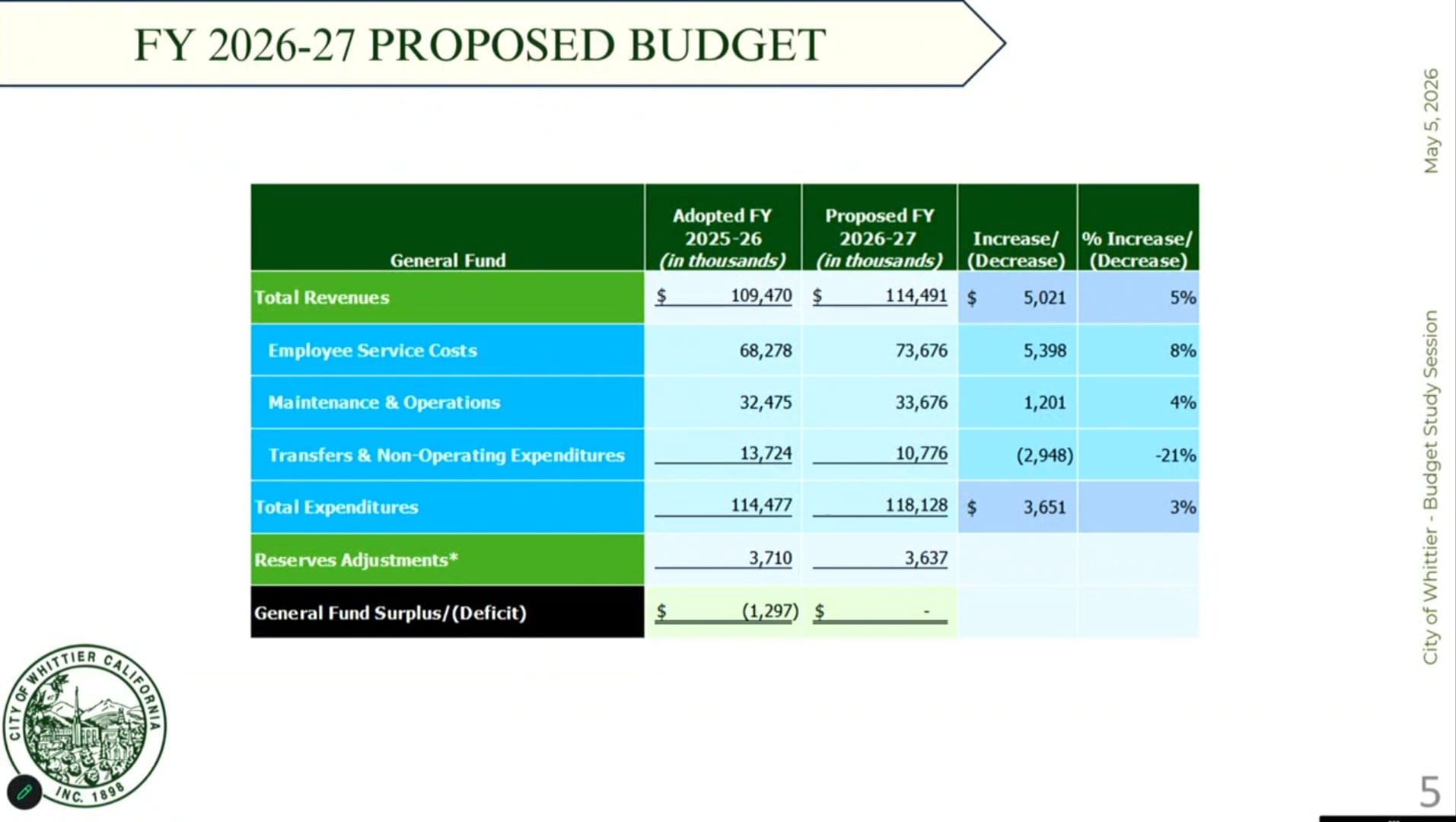
The proposed budget projects expenditures exceeding revenues by approximately $3.6 million before reserve adjustments. The city plans to fill that gap by drawing from reserve funds. On paper, the budget balances. In practice, the city is consuming savings to make that happen.
That would be a manageable situation if it were temporary. The city's own five-year financial plan suggests it is not.
A Gap That Keeps Growing
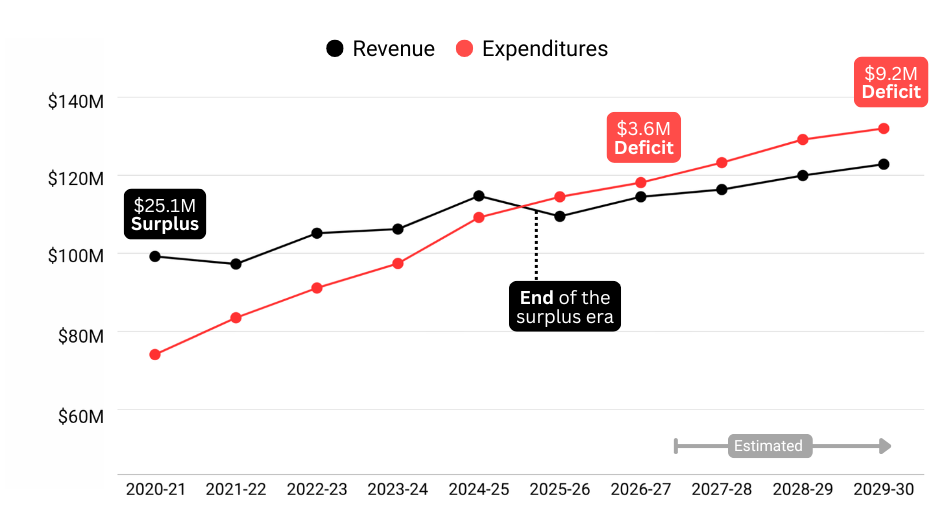
The gap between what Whittier earns and what it spends is expected to grow significantly over the next several years.
The five-year financial plan attached to the proposed budget projects the deficit widening from $3.6 million this year to more than $9 million annually by fiscal year 2029-30. Those projections come directly from city staff documents presented to the City Council in May 2026.
For context, Whittier was taking in significantly more money than it was spending just a few years ago — but those years were unusual, shaped by pandemic-era conditions that have since faded. The longer trend tells a different story. Since 2020, city revenues have grown by roughly 24 percent. Expenditures have grown by roughly 78 percent. Those two lines are moving in incompatible directions, and the gap between them is widening every year.
Why the Surplus Years Were Misleading
For several years, Whittier's budget looked healthy on paper. Two factors explain why that picture was not fully representative of the city's longer-term trajectory.
First, the pandemic years. During COVID, city spending was temporarily reduced — events were canceled, projects were delayed, and the federal government sent cities relief money that offset costs. The city received approximately $16.8 million in American Rescue Plan Act funds beginning in 2021. That money helped fund the Homeless Navigation Center and other services. It was never a permanent revenue source, and it is now exhausted.
Second, a one-time state payment. In 2025, the state of California transferred responsibility for Whittier Boulevard from CalTrans to the city and provided a one-time payment of $16.7 million as part of that transaction. The city set those funds aside in a dedicated reserve to cover the long-term costs of maintaining the road and absorbing the surrounding annexation area — including new staffing, vehicles, and operational obligations. That payment won't happen again.
Both of these one-time payments helped make the city's finances look healthier than the underlying trend actually was.
The Projections Kept Getting Worse
Here's what makes this worth paying attention to: just two years ago, the city wasn't projecting a deficit at all.
In the fiscal year 2024-25 five-year financial plan, city staff projected that fiscal year 2026-27 would end with a surplus of $889,000.
One year later, the fiscal year 2025-26 five-year plan revised that projection to a deficit of $1.1 million for the same year.
Now, the actual proposed budget for fiscal year 2026-27 shows a deficit of $3.6 million before reserve adjustments.
That's a $4.5 million downward swing in two years. In 2024, the city told us this year would end with a surplus. Today the city is projecting a deficit nearly four times larger than what it forecast just one year ago. The biggest driver appears to be employee costs — which came in roughly $3.5 million higher than projected, largely because labor agreements were settled at higher rates than the city had budgeted for.
Raises Approved as the Deficit Was Already Visible
All of this makes one decision particularly worth noting.
On March 24, the previous city council, before they were voted out in April 14 election, approved 27 percent raises over three years for all executives and department directors. The entire police department got the same. The City Manager got a separate 19 percent raise, bringing his base salary to $365,000.
Those raises kick in over the next three years — the exact same three years the city's own projections show the deficit growing from $3.6 million to more than $9 million.
The full cost of those salary agreements was never publicly disclosed.
That matters because employee costs are already the single biggest driver of Whittier's budget gap — accounting for more than half of all General Fund spending. Every year those raises take effect, the pressure on the city's finances grows a little more.
How the City Is Covering the Gap
To balance the budget, the city is drawing from three dedicated savings funds this fiscal year.
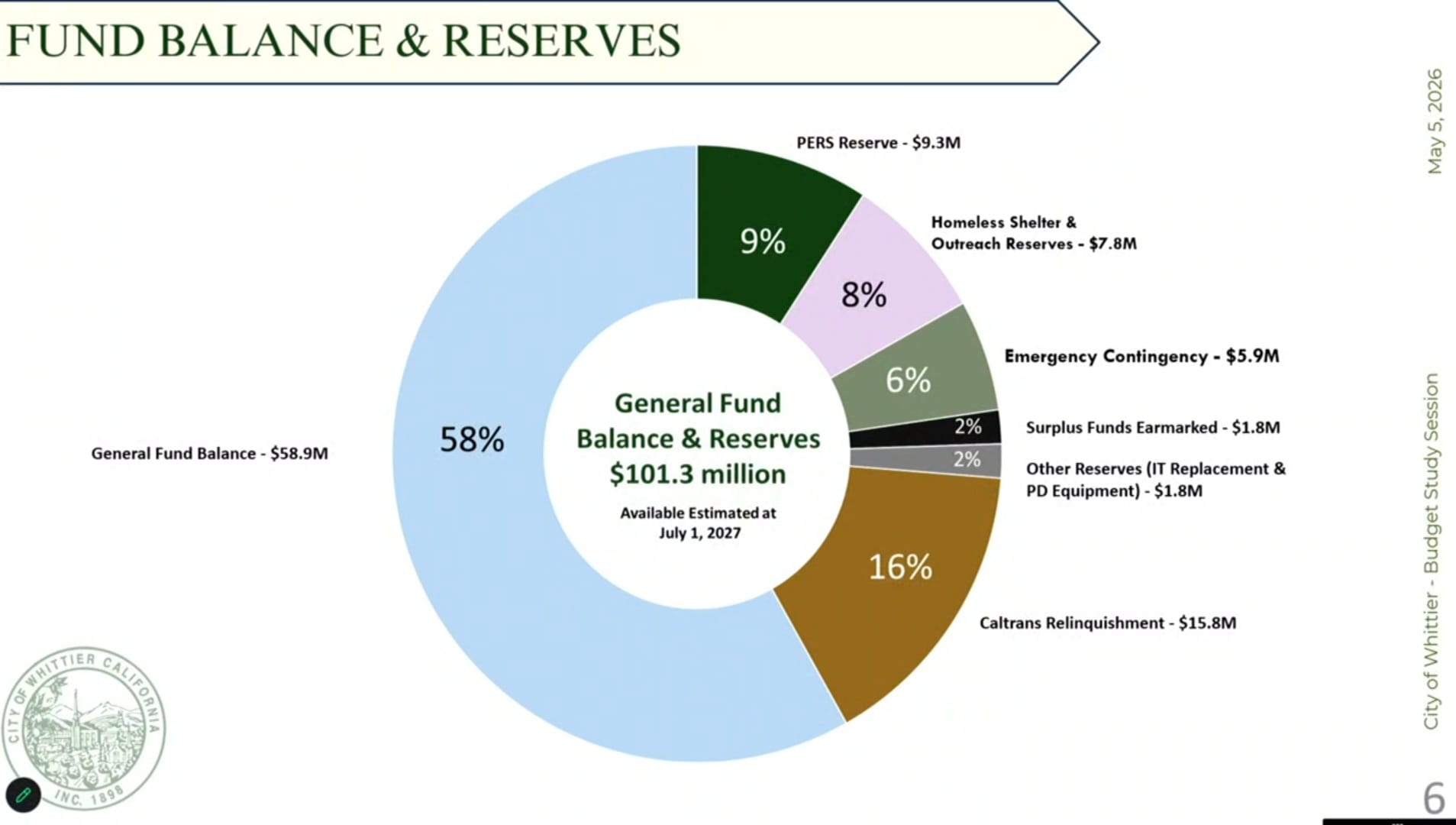
PERS Reserve — approximately $2.36 million drawn to offset rising pension costs. The city's Unfunded Accrued Liability payment to CalPERS has nearly tripled in two years, from approximately $2.2 million in fiscal year 2024-25 to $5.3 million in 2026-27. The PERS reserve was built specifically to cushion this kind of increase. Its balance is projected to decline from $11.7 million to $9.3 million this year.
Homeless Shelter and Outreach Reserve — approximately $2.13 million drawn to fund the Navigation Center and homeless outreach operations. This reserve was originally funded with federal COVID relief money — part of the $16.8 million the city received through the American Rescue Plan Act in 2021. Its balance is projected to decline from $9.98 million to $7.85 million.
State Relinquishment Reserve — approximately $166,000 drawn for Whittier Boulevard and annexation-related costs. This reserve remains relatively stable because only a small portion is being used annually, but it is committed to road and annexation obligations rather than available as a general operating cushion.
It's not as simple as the city raiding one account to cover a shortfall. Each reserve has a specific job. The city is using dedicated savings to simultaneously manage pension costs, homeless services, and Whittier Boulevard responsibilities — while the overall budget structure nets to zero on paper.
It is also worth noting that beyond these dedicated reserves, the city maintains a broader general fund balance — projected at approximately $58.9 million as of July 1, 2026 — which provides additional financial cushion. The PERS reserve draws noted above are specifically for their designated purpose of offsetting pension obligations, not general budget balancing. Whittier's overall reserve position remains stronger than many cities of comparable size.
The question the city's own numbers raise is simple: what happens when those savings run low? Under the current trajectory, the PERS reserve and the Homeless Shelter reserve are both projected to be nearly depleted by fiscal year 2029-30. At that point, the city would need to find new recurring revenue, reduce services, or some combination of both to cover obligations it is currently funding from savings.
What the Projections Don't Account For
One of the bigger unknowns looming over these projections is the city's policing contract with Santa Fe Springs, which is scheduled to terminate in February 2028. That contract currently brings in approximately $17 to $18 million per year — roughly 15 percent of the city's total operating revenue.
The city's own budget memo acknowledges the termination date but states the financial impact has not yet been fully incorporated into long-term projections. That's a significant gap. It's not yet clear whether the contract ending will be a net wash — the city would no longer be spending on those services either — or whether there are deeper financial implications that will need to be managed. What happens to the roughly 30 officers currently dedicated to Santa Fe Springs is also an open question.
The city says it is still evaluating the impact. Until that analysis is complete, the deficit projections in the five-year plan should be read with that uncertainty in mind.
What Comes Next
The City Council is scheduled to continue reviewing the proposed budget at its meeting on Tuesday, May 12. Final adoption is expected in June.
The new council — James Becerra, Vicky Santana, and Aida Macedo, sworn in on April 28 — is encountering these fiscal realities in their first weeks in office. The decisions made during this budget cycle, and in the years immediately ahead, will determine whether Whittier's reserve cushion serves as a bridge to structural stability or is drawn down to the point where the city faces significantly harder choices.
This reporting is based on publicly available documents from the City of Whittier, including the proposed FY 2026-27 budget, the five-year general fund financial plan, and budget proposals and five-year plans from fiscal years 2021-22, 2022-23, 2024-25, and 2025-26.