Who Pays for Parking in Uptown Whittier?
Homeowners, a hospital, and a few big landowners all factor into who pays for Uptown parking.
The Whittier City Council approved the yearly budgets for two Uptown parking districts on June 23, 2026, renewing a pair of property tax assessments that have funded parking in the area since the 1960s.
It's the kind of routine city business that rarely makes headlines, but it touches more residents than most people realize. Some homeowners pay into these districts without knowing it, a private hospital has dozens of parking spaces reserved just for its staff, and a small handful of owners, including the city itself, control a large share of the land involved.
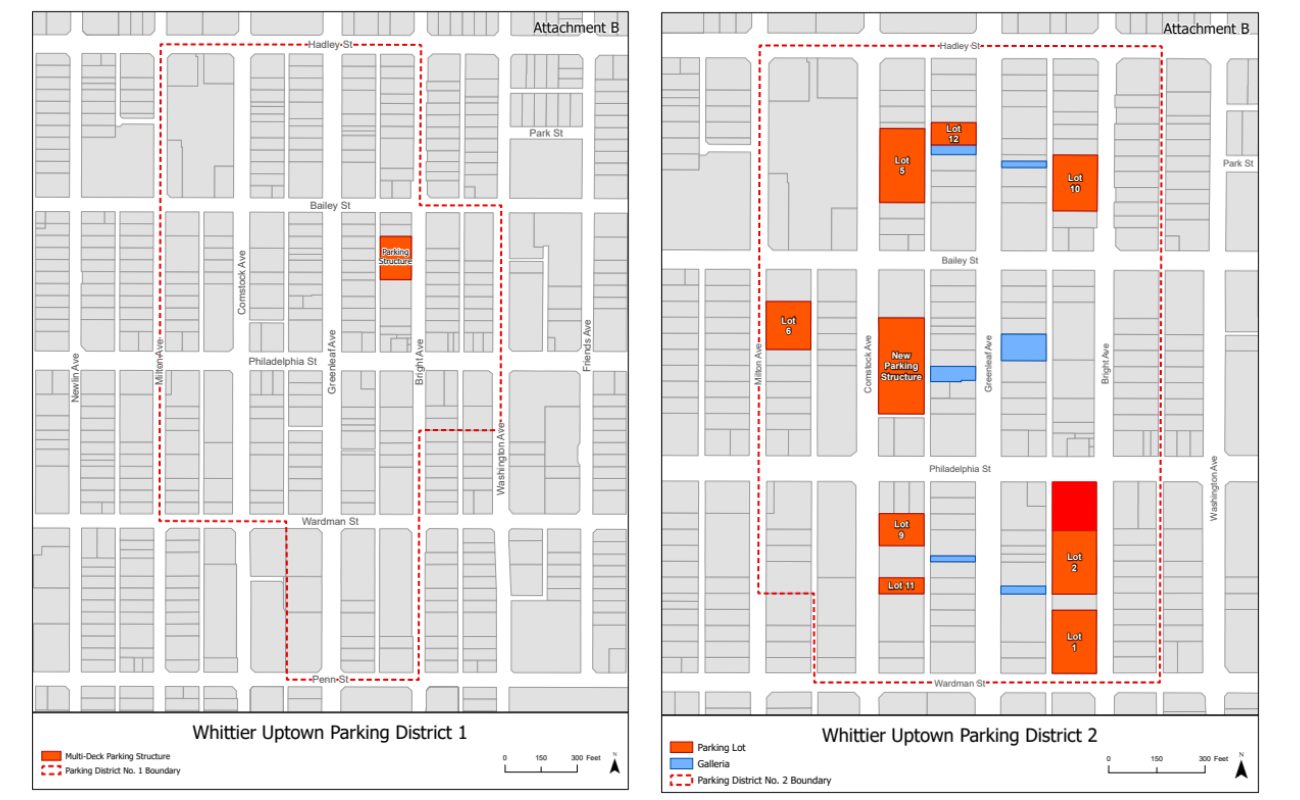
The two districts, Whittier Uptown Parking District No. 1 and Parking District No. 2, cover much of the commercial core around Greenleaf Avenue, Bright Avenue, and Comstock Avenue. Together they fund the Multi-Deck parking structure, nine surface lots, a second parking structure, and six pedestrian walkways known as gallerias.
Here is what the districts are, who pays into them, and what residents should know.
What is a parking district?
A parking district is a special assessment area. Property owners inside its boundaries pay an extra charge, on top of their regular property taxes, that goes specifically toward building and maintaining shared parking facilities in that area. The idea, when Whittier created these districts decades ago, was that businesses and property owners near Uptown would benefit from shared parking and should help pay for it.
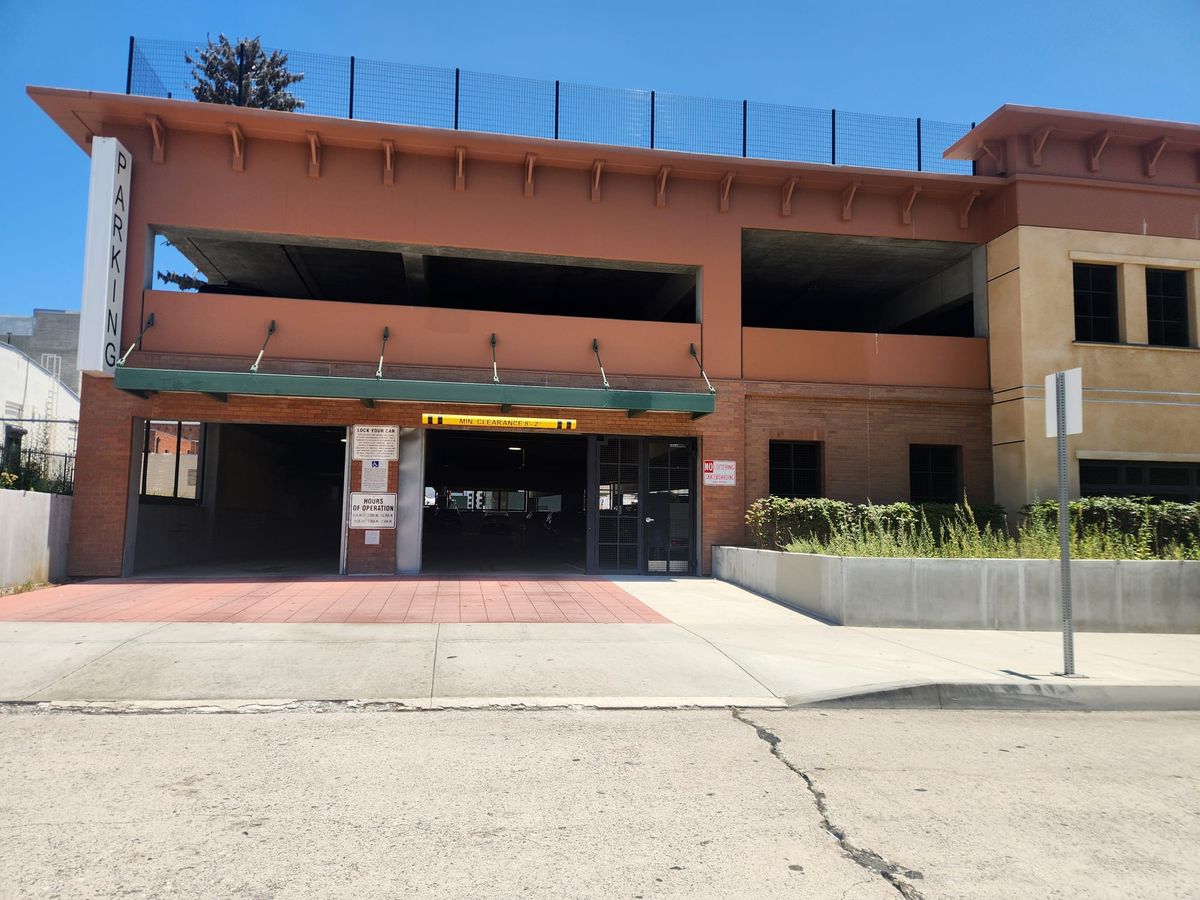
District No. 1 was formed in 1963 to build and maintain the Multi-Deck structure at 6721 Bright Avenue. District No. 2 was formed in 1965 to build surface lots and gallerias throughout Uptown.
The two districts use different funding formulas
District No. 1's assessment is a fixed dollar amount, unchanged since it was set decades ago: $6,850 total, split across 192 properties. That number does not grow with inflation or property values. Most of the district's income instead comes from parking fees. The district's entire annual budget for the coming year is small: $72,385 in revenue against $54,719 in expenses, ending the year with $17,666 left over.
District No. 2 works differently. Its charge is based on how much a property is worth, at a rate of $0.166660 for every $100 of assessed value. Because the charge scales with property value, this district brings in more money and carries a much larger reserve. It is projected to end the coming year with $1,201,769 in reserve, after $422,139 in revenue and $370,767 in expenses. That money pays for sweeping, litter control, landscaping, lighting, and contract security patrols across the district's lots and structures.
Both districts cover overlapping ground. Of Uptown's roughly 190 properties, about 159 sit inside both district boundaries. That means many owners pay into both assessments in the same year, though each property's share of District No. 1's flat $6,850 total is small.
Some of the money goes to reserved hospital parking
Since 2010, the city has set aside a combined 161 parking spaces across both districts just for PIH Health, the hospital system with a nearby campus. That includes 85 spaces on the upper levels of the Multi-Deck structure, plus 76 more split between two surface lots. As of 2021, PIH Health told the city its staff no longer use 52 of those surface spaces, though the city still holds 24 spaces open for the hospital's use. Whether PIH Health pays the city anything for these reserved spaces is not stated in any document reviewed for this story.
This isn't the first time PIH's footprint in Uptown has raised parking questions. In 2019, the city council debated whether to let PIH bring nearly 300 employees to its Uptown offices, with some council members warning that a proposed parking structure risked becoming, in one member's words, "a public gift to PIH." The council ultimately approved PIH's expansion, and the mayor at the time countered that the parking in question was public infrastructure the city was free to allocate as it saw fit. Source: The Downey Patriot.
Whittier Informed asked Deputy City Manager for Operations Kyle Cason by email whether PIH Health pays the city for its reserved parking spaces, through the standard permit program, a separate negotiated rate, or no charge at all. He did not respond by the time of this story's publication.
Homeowners pay into the district too
Parking districts are drawn by geography, not by how a property is used. That means several residential properties on Bright Avenue, checked against Los Angeles County Assessor records, are included in District No. 2 and pay its property-value-based assessment every year, the same as a storefront or restaurant would.
To see what this looks like in practice, Whittier Informed reviewed several residential properties on Bright Avenue against Los Angeles County Assessor records. Two examples show how differently the assessment can land on similar homes:
- A single-family home built in the early 1900s, assessed at $964,450, pays about $1,607 a year.
- A multi-unit residential building assessed at $296,882 pays about $495 a year.
Neither property is inside District No. 1's boundary, so each pays only the one assessment. Because the charge is based on assessed value rather than a flat rate, the amount a homeowner pays can vary widely depending on when the property was last sold. Under California's Proposition 13, a property's assessed value is generally tied to its purchase price and rises slowly afterward, so two similar homes can carry very different tax bills depending on how recently each last changed hands.
Whittier Informed also asked Cason whether the city's own parcels are exempt from the parking district assessments, and if so, whether that increases the assessment amount for private property owners. He did not respond.
Who owns the land inside these districts
Reviewing the ownership rolls for both districts shows Uptown property is fairly concentrated among a small number of owners. The largest are:
- City of Whittier and related public agencies — roughly 40 properties combined across both districts, more than one-fifth of all the land inside their boundaries. Nearly all belong to the city itself, with a handful owned by the Whittier Housing Authority and one by the U.S. government.
- JPMorgan Chase Bank — 7 parcels
- Ess Prisa LLC — 7 parcels
- Hillview Investments LLC — 6 parcels
- Several family trusts and smaller LLCs each hold three or four parcels beyond that.
California law does not require an LLC to publicly disclose who actually owns or controls it. That means it is not possible to determine from public records alone who is actually behind companies like Ess Prisa LLC.
It is also not stated in the budget documents reviewed for this story whether the city's own parcels are subject to the assessments, or are exempt as government property.
Why this matters
These are two small budgets most residents will never notice on an agenda. But they shape everyday life in Uptown: what property owners pay, who gets guaranteed parking, and how a corner of the city's tax base actually works. Knowing that is part of understanding how Whittier runs, whether or not any of it ever changes.
This story is based on Whittier City Council resolutions, staff agenda reports, and public assessment rolls for both districts, along with Los Angeles County Assessor records and California Secretary of State business filings, all reviewed by Whittier Informed.