
What The 2026 Whittier Election Data Shows: Turnout, Voting Trends, And What Comes Next
Whittier's 2026 election drew the highest turnout the city has seen in recent April cycles — but the data behind the numbers tells a bigger story about who votes, where, and why the date of an election matters more than most people realize.
Whittier's April 14, 2026 election drew the highest turnout the city has seen in recent April cycles.
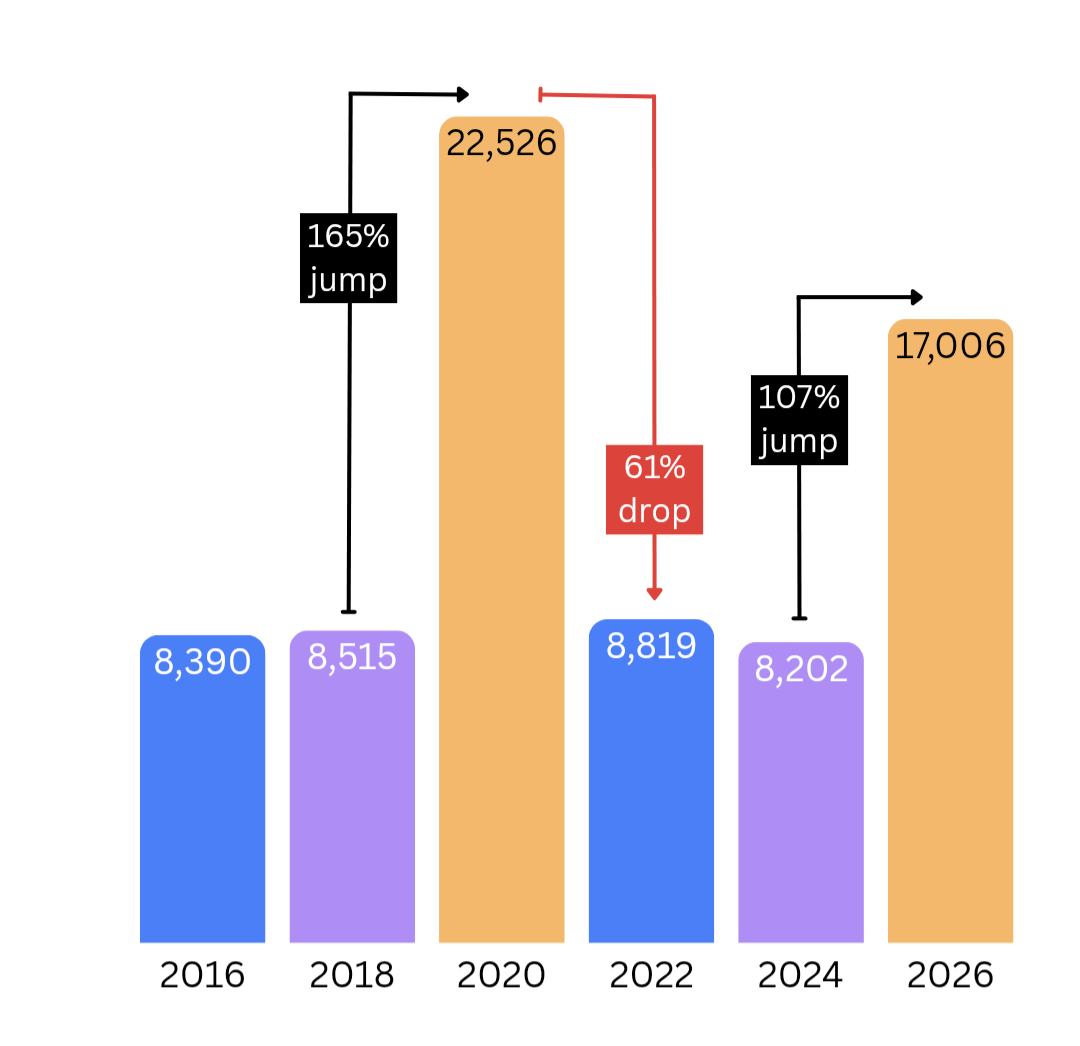
A total of 17,006 ballots were cast out of 59,125 registered voters, a turnout rate of 28.76% and a 107% jump from the 8,202 votes cast in 2024, a sharp increase that points to higher engagement in a competitive race.
The results reshaped City Hall, with voters electing a new mayor and two new council members.
Mayor
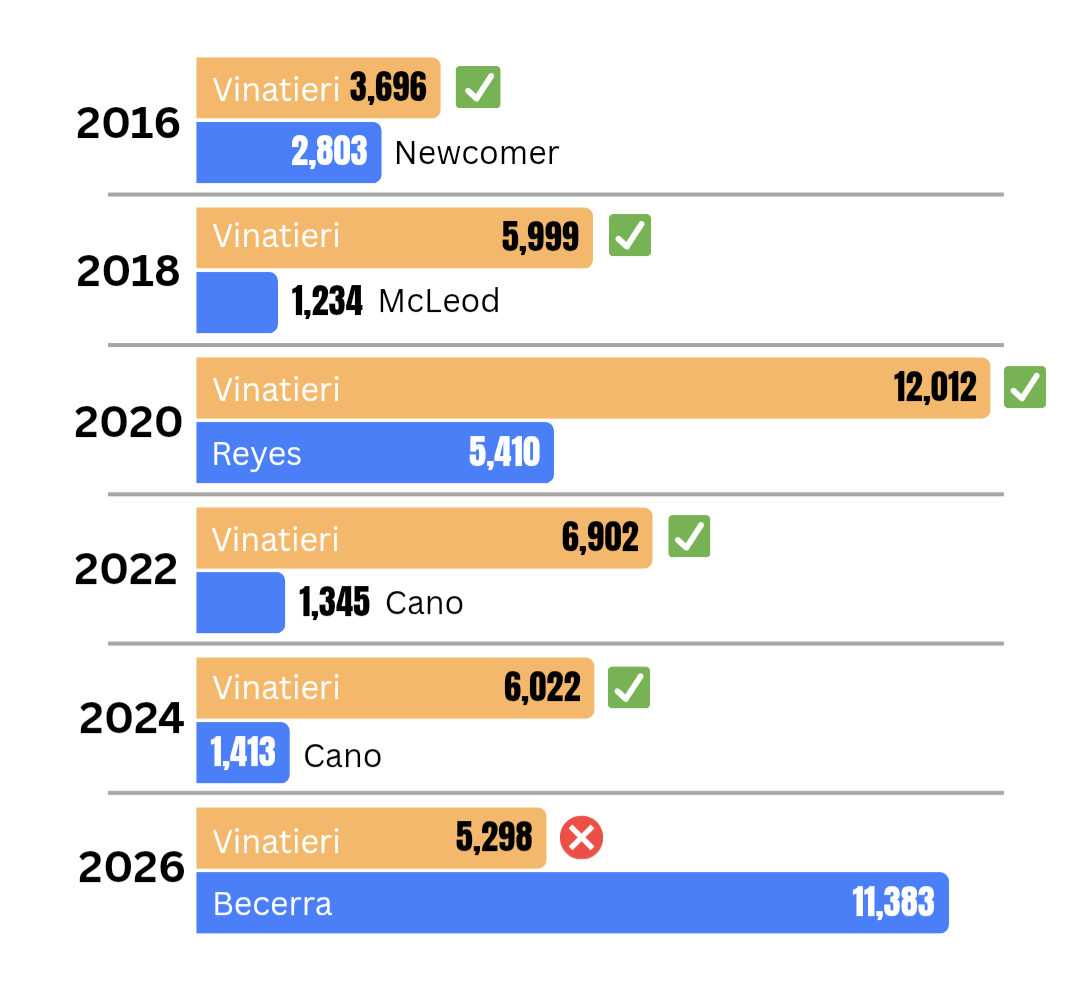
James Becerra defeated incumbent Mayor Joe Vinatieri by a wide margin, collecting 11,383 votes to Vinatieri's 5,298. A third candidate, Isaiah L. Leon Savage, was also on the ballot and received 253 votes.
Becerra won every precinct in the city.
The race ended a decade-long run for Vinatieri, who had served as mayor since 2016 and won reelection in 2018, 2020, 2022, and 2024. His winning margin got smaller with each election, and the 2026 race was not close. Becerra received more than twice as many votes.
Vinatieri's 2026 total was largely consistent with his past performance. Since 2016, he has typically received between 5,000 and 6,000 votes in April elections. What changed in 2026 was not his baseline, but the scale of turnout around him. Becerra's 11,383 votes far exceeded what past challengers had received, suggesting the race drew from a broader pool of voters than prior April elections.
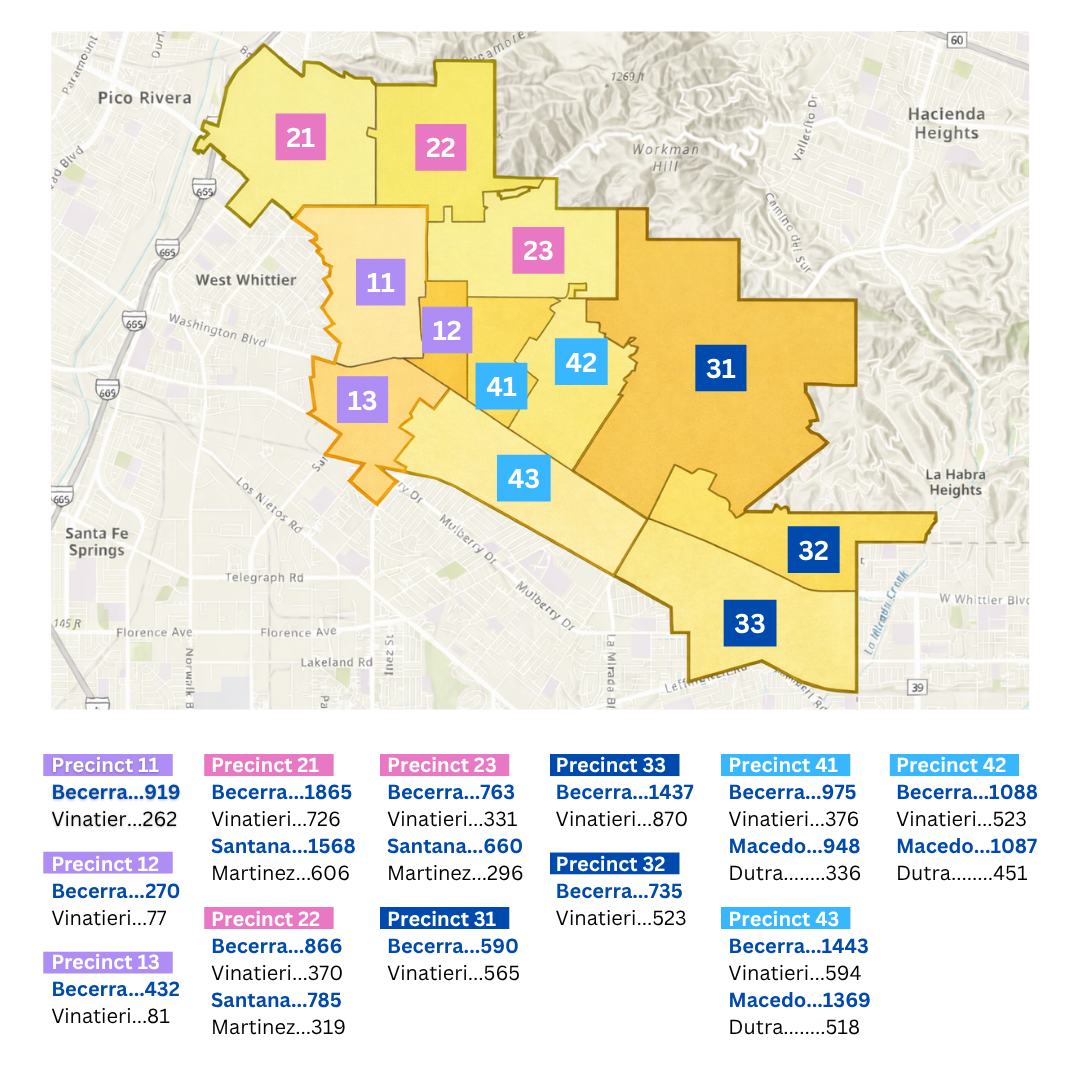
The closest race was in Precinct 31, covering the area around Friendly Hills – including East Whittier Middle School and La Serna High School, where Becerra edged Vinatieri 590 to 565, a margin of just 35 votes.
District 2
Vicky Santana won the District 2 seat with 3,013 votes. Octavio Martinez finished second with 1,221 votes, followed by Rene Ramos with 417, Rolando Cano with 255, and Brian Ahern with 50. District 2 saw 5,017 total ballots cast, a turnout rate of 32.33%.
Martinez had held the District 2 seat since 2022 (only one four-year term).
District 4
Aida Macedo won the District 4 seat with 3,404 votes, defeating incumbent Fernando Dutra, who received 1,305 votes. Phil Longoria finished third with 322 votes. District 4 saw 5,093 total ballots cast, a turnout rate of 33.61%.
Dutra had held the District 4 seat since 2016.
Turnout by neighborhood
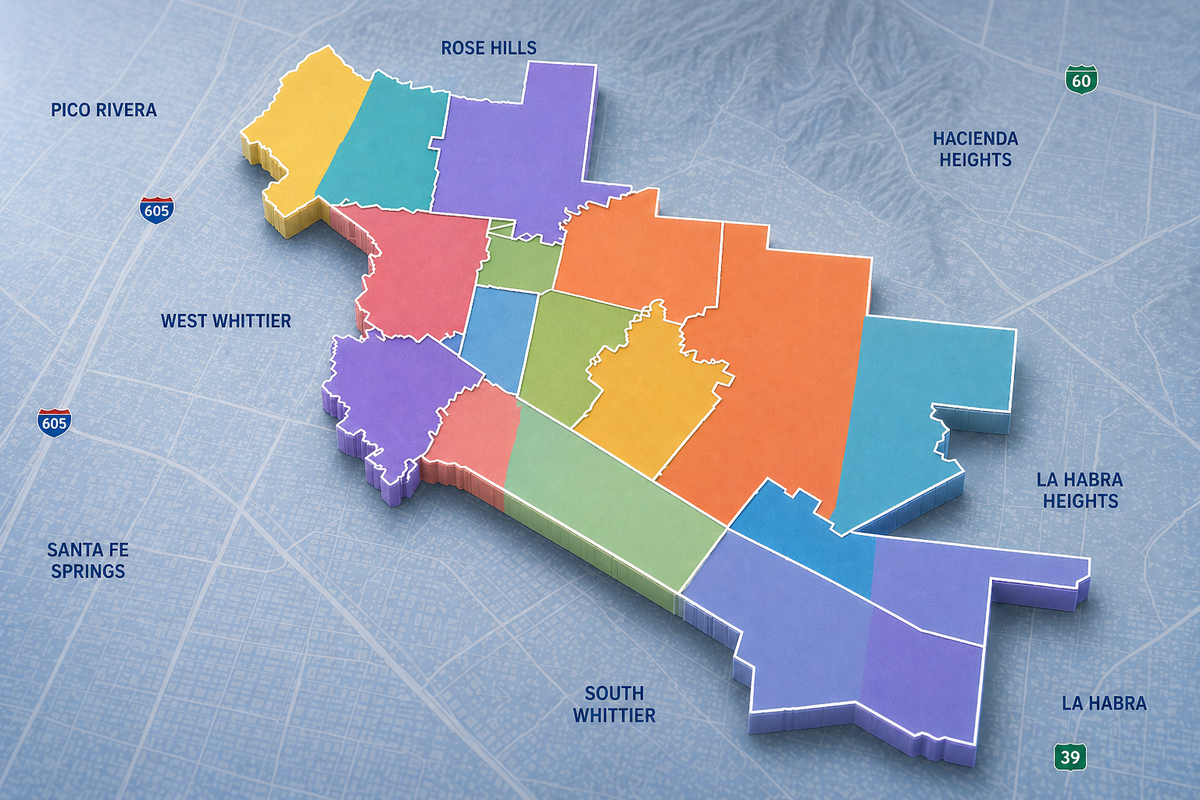
Whittier divides its four council districts into 12 smaller areas called precincts, each representing a specific neighborhood. Turnout can vary significantly between them.
In 2026, that gap was nearly 3 to 1. Precinct 42, located near Michigan Park around Ocean View Elementary, recorded the highest turnout at 44.15%, with 1,637 of 3,708 registered voters casting ballots.
Precinct 12, which includes City Hall and Lee & Erika Owens Park, recorded the lowest at 16.20%, with just 360 of 2,222 registered voters participating.
How people voted
Most votes were cast before Election Day, meaning the outcome was largely shaped in the weeks leading up to it. Of the 17,006 ballots cast, 13,734 (80.8%) were submitted by mail. Just 3,272 voters (19.2%) cast ballots in person.
The bigger picture on turnout
Whittier is an off-cycle city, meaning it holds its elections on its own schedule in April rather than alongside state or national elections in June or November. When voters go to the polls for governor, Congress, president, or high-profile ballot measures on issues like housing, taxes, or public safety, they cast ballots for local races at the same time. In an April-only election, the ballot has just one thing on it: Whittier City Council.
In 2015, the state passed SB 415, the California Voter Participation Rights Act, which required cities with chronically low off-cycle turnout to move their elections to align with statewide dates. Whittier fell under that requirement and moved its 2020 election to March to coincide with the state primary.
The result was immediate. In 2020, 22,526 ballots were cast, nearly three times the typical April total, because residents were already voting in the presidential primary.
In 2018, Redondo Beach had successfully sued the state, winning a court ruling that SB 415 does not apply to charter cities. Whittier, also a charter city, followed Redondo Beach's lead and pointed to that ruling when its City Council voted 4 to 1 in 2021 to return to April elections.
Turnout dropped 61% in the very next election in 2022.
The 107% jump from 2024 to 2026 shows a competitive mayoral race can move the needle even on an off-cycle date. But the overall turnout rate of 28.76%, still reflects the limits of asking residents to show up when nothing else is on the ballot.
What comes next
The council that made that 2021 decision to move elections back to off-cycle is no longer in place. Two of the members who voted to return to April elections, Joe Vinatieri and Fernando Dutra, were voted out on April 14.
When candidates were asked at election forums whether they would support moving Whittier elections back to align with statewide dates, Becerra, Santana, and Macedo each said they would. That decision could play a major role in how many Whittier residents participate in future elections.
The 2026 election results will be certified by the Whittier City Clerk on April 28, 2026.