
Whittier Has 194 Miles of Sewer Pipe, Some of It From 1917. A Contract Typo Got Us Looking
A typo in a routine sewer contract got us looking into the underground infrastructure most Whittier residents never think about.

A routine item on Tuesday's Whittier City Council agenda caught our attention for an unusual reason.
An amendment was needed for what staff describes as a numerical error in a contract with Tunnelworks Services, Inc., a company that helps maintain some of the city's hardest-to-reach sewer lines.
The city approved a five-year agreement with Tunnelworks in February 2025, intending to pay the contractor $149,125 annually. But the agreement mistakenly listed that figure as the total compensation for five years, rather than the yearly amount — a difference of about $596,500 over the life of the contract.
The amendment simply corrects the language to reflect the original intent. No additional work is being added.
That's the whole story, administratively speaking. But the staff report sent us down a rabbit hole into Whittier's underground infrastructure, and we found some things worth sharing.
Whittier maintains approximately 194 miles of sewer pipeline and roughly 4,300 manholes — enough pipe to stretch from Whittier to Ensenada, Mexico. Some of those lines have been in service for more than a century. According to the city's 2018 Sewer Master Plan, the oldest pipes still operating today date back to 1917, predating World War I.
After the 1987 Whittier Narrows earthquake, the damaged Uptown buildings were rebuilt, and in some cases rezoned for more dense development. But the sewer pipes beneath them were never enlarged to match, leaving sections of the system carrying more than they were designed for.
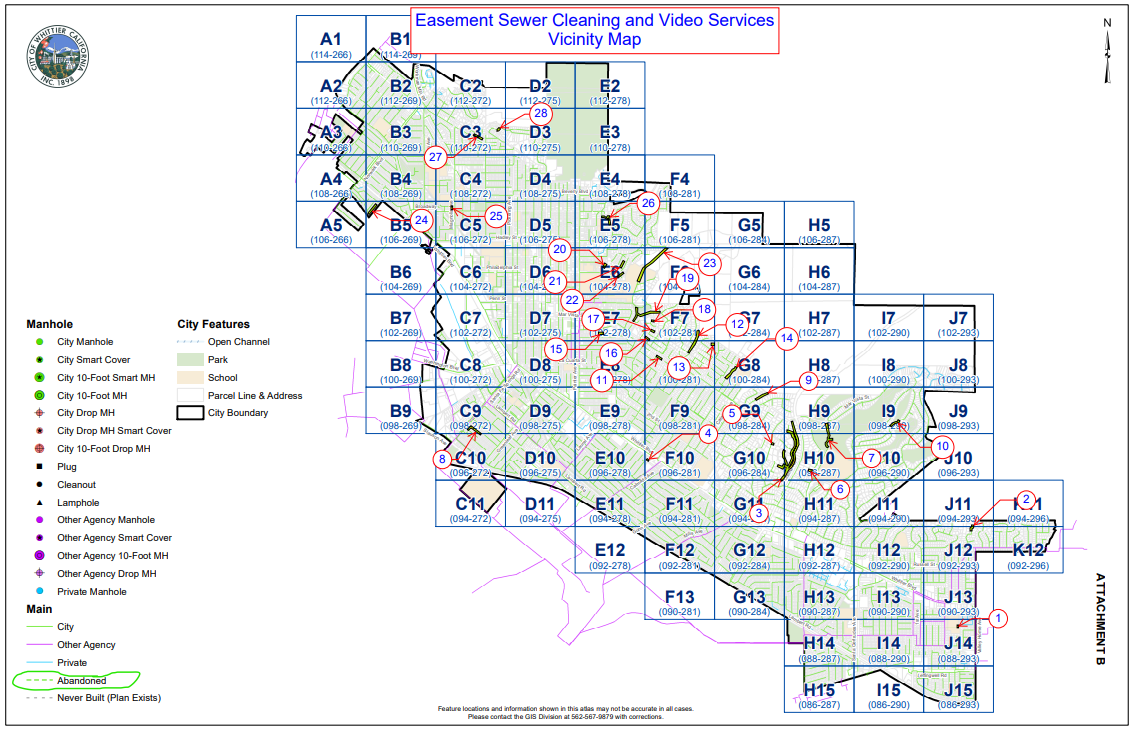
The contract itself also reveals something most residents probably never think about: not all sewer lines are easy to reach. The city is required to clean and maintain all 194 miles of sewer main each year — but about 3.5 miles run through easement areas, behind homes, along slopes, and in other spots where standard equipment can't go. That's less than 2% of the entire network, but it's the portion the city can't handle on its own.
City crews clean most sewer lines using a Vactor truck with a high-pressure 600-foot hose system. In those tight easement areas, the hose has to be operated by hand at reduced pressure, which isn't enough to clear roots, grease, and debris effectively. Tunnelworks brings the specialized tools to do the job — equipment the city determined it couldn't justify buying for such a small slice of the system. At $149,125 annually, the contract works out to roughly $42,600 per mile of easement sewer line cleaned and inspected each year. After each cleaning, cameras are sent through the pipes to verify the work was done right.
Whittier is a designated "Tree City USA," known for the tens of thousands of trees lining its streets and yards. Those same trees are the system's biggest issue: the 2018 master plan found that roughly 57% of the city's recent sewer blockages were caused by roots working their way into the pipes. It's part of why the city now favors PVC for new and replacement lines — its tighter joints are harder for roots to break into than the clay pipe that makes up most of the system.
Worth noting: Whittier doesn't treat its own wastewater. The entire system runs on gravity, carrying roughly 8.8 million gallons of sewage a day downhill through the network until it connects to Los Angeles County trunk lines for treatment elsewhere. No pump stations. No lift mains. Just 194 miles of pipe, most of it clay, all of it quietly maintained year after year beneath the city's streets.
One final note. While reviewing the amendment documents, we noticed that the signature page refers to "Tunnelworks Servies, Inc.", missing a letter “c” in Services.
A new typo in a contract meant to correct an old typo.
Some stories write their own ending.