Whittier's Frontline Workers Are Fighting Back
While city executives received raises totaling roughly 27% over three years, frontline workers say they're being left behind.

The controversy over Whittier's executive pay packages is no longer just a political story. It is now a labor story, and the workers who maintain this city say they are being left behind by what the union calls a take-it-or-leave-it proposal from the city. The union's attorney says filing an unfair labor practice complaint could be a next step.
On June 23, a labor attorney and the president of the city employees union stood before the Whittier City Council and made the case that frontline workers are being left behind while city executives pull further ahead. Their comments were pointed, personal, and on the record.
The Whittier City Employees Association represents the people who fill your potholes, trim your trees, staff your libraries, and keep your water running. They are the frontline workers — the ones residents interact with most but hear from least.
The Pay Gap
Brian Niehaus, a labor attorney representing the Whittier City Employees Association, told the council he has negotiated hundreds of contracts over many years. He said he has never seen a city treat its frontline employees the way Whittier has over the past several months.
Niehaus opened his comments with a number he repeated three times to make it loud and clear.
"Twenty-seven percent. Twenty-seven percent. Twenty-seven percent is what the city has given its executive staff in a salary increase over the next three years," Niehaus told the council.
That number is not in dispute. Back in March, three weeks before the April 14 election, when three incumbent council members lost their seats, the outgoing city council approved sweeping compensation increases for executive staff:
- 9% raise in 2026
- 8% raise in 2027
- 8% raise in 2028
Combined, that totals roughly 27% over three years. City Manager Conal McNamara received the same raise structure on top of a separate 19% salary increase, bringing his base pay from $306,648 to $365,000, less than one year into his tenure.
Seven director-level positions also received a separate 2% salary increase, applied before the first raise, because a compensation study found those positions were already below market rate.
To understand the scale of that gap, it helps to look at the full picture.
According to the city's 2026-27 Salary Resolution, a frontline field or maintenance worker in Whittier starts at roughly $45,000 a year. The City Manager currently earns $365,000 — more than eight times that. And it goes beyond base salary. Executive staff can cash out up to 200 hours of unused vacation every year, which at director-level salaries can add tens of thousands of dollars on top of their pay — every single year.
Then there's the severance package the outgoing council locked in for City Manager McNamara. If the new council ever decided to replace him, it would cost taxpayers up to $547,500. That is more than 12 years of pay for a city worker earning $45,000 a year — gone in a single payout.
That is the gap Niehaus was talking about.
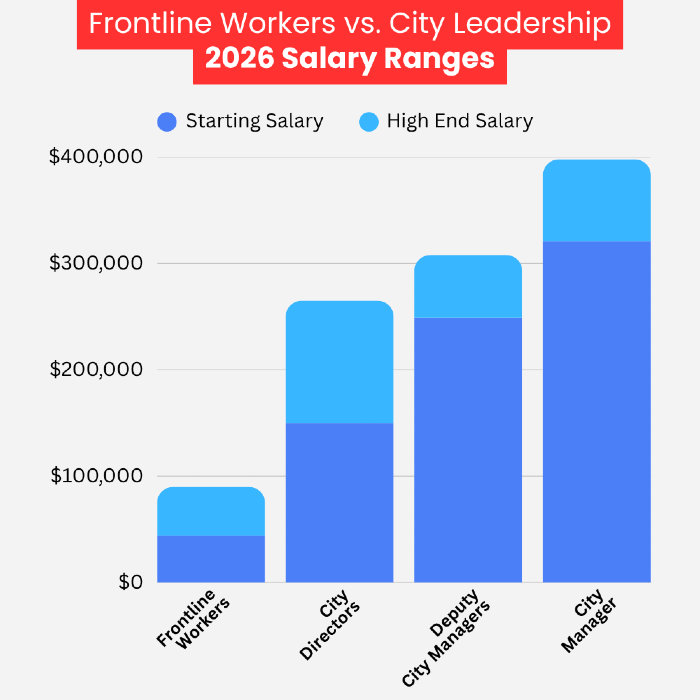
Niehaus said the association is not asking for the same 27%. But he argued that what the city is proposing for frontline workers would make that gap even wider.
"What you're proposing for these frontline employees will create a chasm between those at the top and your frontline employees," he said.
He also raised the issue of health insurance. In a follow-up email to Whittier Informed, Niehaus said frontline workers are the only group being asked to absorb any new medical costs under the city's current proposal. Executives, managers, and police would all have their premium increases covered by the city.
"You're not asking the executive staff to pay a dime more for their medical, but you're asking these men and women, the frontline employees, to pay thousands more," Niehaus told the council.
The exact dollar amount frontline workers could end up paying is unknown — because how much medical premiums will increase over the next three years is also unknown. The city has presented the proposal on a take-it-or-leave-it basis, according to Niehaus.
The Workers Behind the Numbers
Robert Marquis, president of the Whittier City Employees Association, followed at the podium. He represents more than 150 city employees.
Marquis's two-minute remarks were honest.
On turnover, he told the council that in his eight years with the city, the water division alone has cycled through roughly 30 employees — including 10 engineers, 25 streets division workers, and too many parks employees to count.
On morale, he described the experience of being told repeatedly by management that employees are valued — only to receive a contract offer he said tells a different story.
"Every time upper management and executives tell us we are appreciated and the council has their full support, only to offer us a contract that falls short of what they give themselves, and then have the audacity to ask us to be the only bargaining unit to pay more for insurance," Marquis said.
Marquis also alleged that some workers had been discouraged from attending Tuesday's meeting, saying employees had heard that names would be taken — a warning that showing up could come at a cost.
Then he described what his members actually do. They maintain a water system he called one of the most challenging in California due to the city's rolling terrain. They pour concrete and asphalt on streets lined with mature trees that create constant maintenance demands. They staff parks that require workers to serve as arborists, plumbers, landscapers, and playground technicians all at once. They staff the recreation department that puts on the EGGxtravaganza during Easter, Concerts In The Parks in the summer, and countless other events.
Engineers, planners, and building and safety employees face the challenge of moving a 120-year-old city into the future. Work where, as Marquis put it, "the phrase 'just how we planned it' is rarely ever spoken."
He closed on something more personal. "I've chosen to stay with you over opportunities to make more money elsewhere," he said — and talked about how that choice weighs on him when it comes to providing for his family.
What Happens Next
Niehaus said the association is considering filing an Unfair Labor Practice charge with the Public Employment Relations Board, citing what he described as unlawful actions by the city's negotiating team over the course of negotiations.
The next formal step in the process, he said, is a declaration of impasse — which would trigger mediation and fact-finding.
The specific proposals under negotiation have not been made public. Whittier Informed reached out to the City of Whittier for comment. The city did not respond prior to publication.